Categories
Census First World War One Hundred Years Ago People

From Badingham to Burton – who were those who followed the barley?

Seasonal work and the winter push

The rhythm of the seasons has always impacted the human race – in more recent millennia, when to plant, when to harvest. In East Anglia, the harvest brought opportunity for employment to thousands of agricultural labourers for centuries. There was winter work, too, but the workhouse loomed larger for many. Stone picking and digging bush drains might be options, but what if wages were higher elsewhere? What if mechanisation was increasingly used for threshing? What if young men and women could see opportunity elsewhere?

For young, strong men with fewer family ties, especially those with intermittent work who were underemployed or unemployed, there were options. We know about the growth of industry in the north, fruit and hops in Kent, the pull of urban areas, but this post is about a place and a period of history we hear less about. Anyone who has spent time perusing the census enumeration books for Badingham and Cransford will have seen a relatively frequent birthplace appearing by 1901 and 1911: Burton upon Trent.

There’s a very good reason why. 

In the late 19th century, several workers from Badingham and Cransford, in common with other ‘Suffolk Jims’, followed the barley. With the harvest out of the way by September, workers could travel the approximately 150 miles to Burton to help with malting the very crop they had gathered. A few months later, they could return home as the barley ripened once again, making the most of the economic opportunities in both places. 

This migration wasn’t always a permanent move, or a population turning its back on a rural way of life. But it was a way for people to avoid parish relief and to enjoy better wages than might be had at home throughout the winter.

For this post, I set out to see just how many of my Badingham and Cransford One-Place constituents had confirmed links to Burton upon Trent. I found far more than I imagined, and I’ve ended up with a significant piece of research. It’s been fascinating to see the micro histories of the people and names we might recognise playing out the macro stories of industrialisation, boom and decline, and the ebb and flow between places.

The people in these stories were connected in multiple ways – they were families, communities, and otherwise economically associated. Their networks are shouting from the documentary record in a way I didn’t expect, but in a way that could easily be missed if we were looking at just the occupants of a house, or the direct line of a family tree. 

My exploration doesn’t pretend to capture everyone who made the journey from Badingham and Cransford to Burton, nor every season they may have spent there. As genealogists, we are schooled in making robust conclusions, but sometimes we need to build a narrative around the ‘why’ to tell a more interesting story that goes beyond names and dates. A census places a person somewhere, but local history suggests why they were there in that place at that time. What follows is necessarily partial, shaped by what I’ve found in the creation of this post. I offer it as a representative collection of case studies, organised chronologically by arrival in Burton and how that maps to the development and later decline of the brewing industry in the town.

I welcome comments from others who have traced similar paths from this part of Suffolk, so that this shared history can continue to grow in this little part of the internet.

Some context and sources

Burton was booming in the late 19th Century, turning out 980,000 barrels of pale ale a year in the mid-1870s vs 70,000 in 1840. Huge names in the industry, such as Bass, Ratcliff & Gretton Ltd and Samuel Allsopp & Sons, needed temporary labour for malting from September to May, fitting nicely outside the months of the home harvest. By the end of the 19th century, Burton had the most extensive beer breweries in the world, supplying as much as a quarter of all the beer in Britain: more than 3,000,000 barrels a year, the brewing of which employed more than half the town’s burgeoning population. This level of production, possible due to a combination of Burton-specific factors, was unique in the UK.

A couple of sources inspired this post. First, appendices from George Ewart Evans’ Where Beards Wag All, which contain lists of East Anglian workers who migrated to Burton, many of them from this area. Second, that most-consulted but endlessly fascinating record collection, the decennial census. There are, it turns out, plenty of people moving between Burton, Badingham and Cransford, identified within census folios simply by dint of their birthplace being different to their home on census night. My subsequent methodology included creating profiles for these men and women, as well as investigating their immediate families, adding plenty of new faces and stories to my online OPS family tree. It must be said that the long-overdue digitisation of Suffolk registers has been a boon in the past couple of weeks, but alas, Badingham’s registers are not yet among them.   

In my initial foray into available sources, I had a lovely surprise. An RQG colleague, Carolyn Alderson, has published her Genealogical Investigation of the Suffolk Seasonal Maltster Migration in 19th Century Burton upon Trent in the RQG journal. Carolyn identifies Henry Edwards Junior, born 1815, as the initial catalyst for the seasonal migration. Henry was a maltster, manure and corn merchant from Woodbridge who saw an enormous opportunity for the Woodbridge area to make additional profit from its barley. Advertising in 1858 for ‘young strong able agricultural labourers’, Henry played his part in encouraging Suffolk-Burton links…and word spread among local people.

I think that ‘spreading of the word’ was vital, and goes a long way to explaining why Suffolk made up such a large proportion of the seasonal labour in Burton. If your employer has openings, and you have family and friends you can recommend, then you send word, or at least, next year when the brewery agent comes to Framlingham Crown, you take them with you. If you made a relatively good living in Burton in 1878 vs clearing ditches on the days the sun shone in 1877, then you return in 1879 – and you bring your younger brother and perhaps even your new wife.

Not yet here for the beer (1841-1861)

The first Badingham and Cransford-born workers in Burton predate the beer boom. It’s important to note that because we’re going back to 1841 here, the date of the census matters. From 1851-1911, the census was taken in late March or early April, but in 1841, it was taken in June. This means that seasonal labourers might have been back in Suffolk and thus missing from the returns taken in Burton that year. However, beer production in Burton was still relatively low.

Our first case studies are all women, not the enterprising ‘strong able agricultural workers’ – and most likely young men – Henry Edwards’ ad might have evoked.

First, we meet Harriett, Badingham-born but in Burton for that first commonly-accessible census, the 1841. This is early, and the census reflects this – Harriet was married to George, who wasn’t a maltster but a shoemaker in both 1841 and 1851.

It’s possible this is Harriet Wood(s), baptised in Badingham in 1794. There is a marriage in London on 20 December 1835 at St Dunstan and All Saints, Stepney, between a widowed George Port and Harriet Wood. For the purposes of this post, this is a circumstantial suggestion, not yet a robust conclusion; that said, the other Harriets baptised in Badingham during a similar period all appear to be accounted for.

Harriet and George seem to have moved to Burton for good; Harriet lived on the market place and died in the town in 1855. As such, Harriet doesn’t fit the narrative of a seasonal worker, or the wife of one. Harriet and George’s lives brought them to the town via London in middle age, but not as a direct consequence of brewing or directly from village life.

Our next women migrants are a pair of sisters, Eliza Ann and Clara Barham, daughters of a Badingham family headed by John and Sarah Barham. Much younger than Harriett, Eliza was baptised on 24 January 1842, and Clara was born in 1855. The Barham family lived near the Bowling Green Inn in 1851. Interestingly, at that time, the head of the household was Sarah, the girls’ mother – a ‘drillman’s wife’. Just where was John? Hold that thought.

Eliza married young, in 1860. Her groom was John Rowe, born in nearby Bramfield. By the time of the 1861 census, the couple were living in Burton where John, too, was a drillman. Eliza had taken six-year-old Clara with her. John was most likely the young, strong, hearty agricultural labouring type that the beer makers were beginning to look for – but just like George Port, he wasn’t a maltster.

Back to John. Sometimes you need to use multiple sites to search census returns to find your man! It turns out there was an earlier Drill Man (sic) in Burton Extra, and sure enough, it was Eliza’s father, John Barham, who was lodging with his brother at a ‘Nail Manufacturer and Beer House Keeper’s’ on Water Road in 1851, while he was missing from Badingham. John’s brother Henry was a drill man too, and over in Stapenhill, there’s yet another Barham, William, with the same trade.

So here’s an example of networks in action, this time, over two generations of the same family – even if it’s not in beer. I think the Barham family were all connected to seed drills – Smyths, which was to become world famous, was based in Peasenhall, busily creating new generations of seed drills right next door to Badingham. Men like the Barhams, many of them from the Peasenhall area, were taking them out into the world, earning money as skilled contractors who could sow faster and more consistently with a new drill than by hand.

I wonder whether, while this Badingham-Burton connection is for a different trade, it nonetheless started to build bonds between the two places. Growing grain naturally leads to malting grain, and the first Barham drillmen would have met landlords and scoped opportunities. Theirs was a big family in a small community back home and they would have returned to Suffolk with intel to share. It’s perhaps telling that in Where Beards Wag All, yet another Barham appears on the Bass, Ratfliff & Gretton Ltd list for the 1926/7 season, indicating that the connection may have stretched and adapted over another generation or two.

The next question becomes whether Eliza and Clara remained in Burton permanently. The answer is no. On every other census, John and Eliza were living locally: Peasenhall, Rendham, and finally Derneford Hall and then Pound Farm at Sweffling, where John rose to become Farm Bailiff. Those early days as a contractor bought him experience and a roof over his head before he could secure better employment at home. Eliza and John, by 1911, were parents of ten surviving children (from a total of eleven); this is a Badingham-Burton family that likely has many descendants today. Clara, too, was a short-term resident of Burton. She later married Frederic Button Roe (sic, no w this time) and lived in Cransford, Peasenhall, and Horham.

When moving to malt became an intentional choice (1870s-1880s)

The railway branch line at Framlingham opened on 1 June 1859, joining the town to the East Suffolk Line just north of Wickham Market at Campsea Ashe. For those looking for employment, this might have made the journey to Burton – and the decision to go – a little easier. The expansion of the railway network certainly boosted Burton’s ability to distribute ale and scale production to meet the increased demand. That increased demand meant more workers, and deliberate migration specifically to malt barley.

Our next case study was living a few doors down from the Barhams in 1861. I don’t think it’s a stretch to imagine Burton being a topic of conversation at the bar at the Bowling Green Inn. Perhaps Arthur Goodchild was enjoying a pint one evening in the mid-1870s, bemoaning his winter prospects, when old man Barham told him there was a good living to be made in malting.

Arthur Goodchild was baptised in Badingham in 1858, and, like so many others in this post, the son of an agricultural labourer. It’s always important to stress that the census is taken only once every ten years, but there is so far no reason to believe that Arthur didn’t spend his childhood in the village between censuses. When he was about 18, he married Rosanna Whincop from neighbouring Peasenhall. Arthur and Rosanna must have left for Burton soon after their marriage because by the time the 1881 census rolled around, they already had two children born in Burton. Maybe Arthur had already been in Burton for a winter season or two before his marriage. Unlike those we’ve met so far, Arthur appeared on the census as a maltster – our first documented.

Networks are again in action here, not just because his neighbours had already been finding work in Burton, but because Arthur himself had already got a lodger – his younger brother John, who didn’t show in the initial searches as his birthplace is noted as ‘Baddington’ (near enough!). For John, his migration to Burton was just the start. While I haven’t researched him in any depth just yet, it looks like he headed to Penge and then Hammersmith before ultimately emigrating to Australia (all while sporting a very handsome moustache!).

For Arthur and Rosanna, it looks like Burton became their home for several years. Again, while we have to remember that the census is a snapshot of one evening, all five of the children with them in 1891 were born in the town, and Rosanna’s widowed mother, Priscilla, was also living with them in Burton, along with a new lodger learning the malting trade from Arthur. The family setup suggests rather more permanence than if Arthur were simply lodging somewhere. By 1891, with brewing reaching its peak, there would definitely have been work to support a whole extended family year-round. What’s more, experienced maltsters hosting lodgers ensured a reliable, sustainable source of new labour for the breweries. That said, the connection with Suffolk remained strong; by 1895, Arthur was back. Sadly, we know this from his death record. He was just 37. Arthur was laid to rest where it all began, in Badingham, on 18 June 1895.

For Rosanna, the future remained Burton, even without Arthur. In 1901, she was working as a charwoman there, supporting her children as a second generation in the town. It was a similar picture in 1911, by which time Herbert and Bertie had followed their father into the trade, and in 1921, when she headed a multigenerational household of coopers and wood turners, including grandchildren. Rosanna never remarried. She died in Burton in 1928.

There is another man from Badingham who first appears in Burton in the 1891 census. This chap is Robert Dunnett, who also appears, as ‘Robert Drumett’, in Appendix One of Where Beards Wag All (‘hired by Bass, Ratcliff & Gretton Ltd for work in Malthouses in Burton-on-Trent, 1890-1891 Season’). Unlike Arthur, we know that Robert was probably, at least initially, a seasonal worker. Robert was among three young maltsters from Suffolk boarding with a family on Waterloo Street on that census night.

Robert had previously lived on eight acres farmed by his father John in Badingham, and came from a large family. We know he came and went from Burton because in 1901 he had returned to Suffolk, living at a property near Stark Naked Farm in Flixton. Robert was at that time a horseman living with a stockman and his family. Without this 1901 record, it might have appeared that Robert had gone to Burton and stayed, because the next we see of him is his marriage to Hephzibah Harriet Bullen back in Burton upon Trent.

Robert’s marriage, taking place in February 1903, would have been during the traditional malting season. Hephzibah was a widow, having previously been married to John Bullen, another East Anglian maltster whom she had married at Stoke Holy Cross in Norfolk before moving to Burton and raising a family. Poor Hephzibah lost Robert and found herself a widow again just a year after their marriage. She later married a third maltster, Tunstall-born Suffolk man Horace Reeve, who worked for Bass Co. It seems Horace and Hephzibah both died in Burton, too. A decision was made, quietly or otherwise, to abandon any seasonal movement and make a permanent life in the town; Horace was still working for Bass in 1921. Hephzibah’s story rather suggests that the men from Norfolk and Suffolk in Burton were part of a smaller community within the whole – was it coincidence that all three of her husbands were from the same area, or evidence that they mixed in similar, smaller, circles? Evans’ recollections might suggest the latter – men in different clothes with different accents to their Staffordshire counterparts, who arrived together on a one-way ticket from their local railway station and stayed together thereafter.

The peak of the pull of the Burton pint (1890s)

By the 1890s, enormous breweries in Burton were well established. Beer was being brewed, yes, but the industrialisation of that process brought with it a whole supporting infrastructure and a growing population. Those people from Badingham and Cransford who first appear in Burton in the 1901 census reflect both brewing and its inherent infrastructure. There is a new diversity to the occupations recorded in the census, and the routes our people take after appearing in Burton. 

It was another family affair for the Bakers. Harriet Baker, daughter of William and Sarah, was baptised in Cransford on 23 December 1866 alongside her cousin, Frederick Ife. Both would find themselves in Burton. Harriet moved for work regularly while she was young. Moving from a cottage near Fiddlers Hall, she became a housemaid in Theberton in 1881 and was promoted to cook at a small temperance hotel called ‘Shaftesbury’ in Colchester by 1891.

Perhaps another domestic role took Harriet to Marchington Woodlands in Staffordshire (west of Burton) by the time of her marriage to Alfred Smith in 1896. Alfred was a Staffordshire man born in Silverdale. The birthplaces of their subsequent children suggest they moved to Branston, rapidly growing into Burton, around 1899. Their address of Clay’s Lane in 1901 places them in 19th-century housing that crept along the main road towards the town centre as the town boomed.

Alfred was a carter for a coal and corn merchant. Both of these commodities were vital to Burton’s breweries in the Victorian era. While corn and barley are of course different, a corn merchant would sell both, so that part is obvious. But coal? It turns out that it took between 31 and 85lb of coal to produce a single barrel of beer, depending on the specific processes and equipment available. According to a paper by Nevile in 1906, the coal wasn’t just required for boiling, but for heating liquor for mashing, providing steam for washing casks, and to provide motive power. Alfred was moving the ingredients for a flourishing, coal-fed, Victorian industry. In this endeavour, he was supported by his wife’s Cransford cousins, who were coal miners and railway engine drivers at Newhall, four miles away.

Then we have William Eagle, a young man born in Cransford in 1872 and raised in Culpho – and another agricultural labourer’s son. William’s father, George, remained working for the Hunt family of Culpho for over half a century, his obituary remembering him as strongly religious and exceptionally capable: ‘a thatcher, engine-driver and farm foreman…particularly expert in sowing artificial manures [and] sowing with both hands, so that he did double the amount of work in a day’. I suspect William was not baptised in the village church at Cransford because his family were Baptists; he was by no means the only non-conformist in the parish by this time – the church baptism register is exceptionally quiet in the early 1870s.

William had left the family home by 1891 and married Agnes Sarah Marven in Hendon, Middlesex in 1898. The pair probably remained in London until shortly before 1901 (their daughter, Agnes, was born in Cricklewood). William was not a maltster, but a railway wagon repairer. So, he didn’t follow the barley directly, but like Alfred Smith, he was a vital part of the brewing industry in another way. Burton could only have exported beer as it did with the help of the railways. Without an efficient transport system to distribute it, beer would have remained a locally produced commodity for the most part, instead of production becoming focused in a small area.

It struck me here that Harriet had been working in a temperance hotel and William grew up in a strongly religious household. We don’t know from these records whether they were teetotal, but could it be significant that they were working on the infrastructure side, not in the breweries directly? Evans’ recorded recollections remember Suffolk’s seasonal maltsters as hardworking and hard drinking, singing and dancing through pub after pub. Was it possible to participate in Burton’s economy without endorsing its drink?

A return to rurality?

We move now beyond the zenith of brewing in Burton. The discovery of ‘Burtonisation’ made it possible for companies outside the town to make water resemble Burton’s. Having had more than thirty large-scale breweries in the late 19th century, seventeen remained in Burton in 1911. While these were still a significant source of employment, the micro again reflects the macro in our Badingham and Cransford case studies – by 1911, we see children born in Burton back in Suffolk.

But before we meet those children, we need to revisit the Smiths and the Eagles from the previous section. Did they stay in Burton, or were they affected by the decline in production and profitability?

First, the Smiths. Harriet and Alfred left, but didn’t travel very far; some of their cousins, the Ifes, did remain. While several of the Smiths’ children were born in Burton, the next census, in 1911, places them in Church Broughton, about ten miles north-west, where Alfred was working on his father’s farm. Perhaps there is truth in the suggestion that the industry was a young man’s game; perhaps his family farm just needed him back as farming crept out of depression, and Burton offered diminishing returns. By 1921, Alfred and Harriet were farming on their own account. Harriet’s father had been noted as a pauper back home in Cransford, labouring on another man’s estate when he could. We can hope Harriet felt her efforts had paid off.

As for the Eagles, the family chose Burton as their permanent home, but it wasn’t without change. The 1911 census finds William, now that much older, as a dental mechanic – a ‘working man’s tooth puller’, potentially making teeth to fit as well. There’s a fascinating article on this called ‘Monty, Bring the Blood Can!…’ by Claire Jones if you’d like to learn more. Clearly, this was an occupation that suited William; he was working for Ernest Street Dentist at 75/6 Horninglow Road in 1921 as well. Meanwhile, his daughter and sister-in-law worked at Bass & Co. and Crosse & Blackwell, respectively. Crosse & Blackwell was in the process of opening a factory in a former WWI machine gun factory at this time, representing a new and diversified industry in town – one that would soon after (but not for long) make the famous Branston pickle. William remained a dental mechanic until he retired, passing away in Burton in 1946.

Back to the Hammond children. Arthur, Albert, Rose and Maud were all born to John and Alice Hammond while John was working in Burton. The family (minus Maud, who was by then a live-in servant at The Red House) was at Stone Cottage, Badingham in 1911. The second youngest, Rose, at ten, was the last child born in Burton. The 1901 census must have caught them not long after they returned to Badingham. The family were living on Carrs Hill, not far from Colston Hall. John Hammond was 40 at that time, working as an ‘ordinary farm labourer’. Arthur, Albert, Maud and Rose have all had ‘Lincolnshire’ Burton replaced for Staffordshire – someone perhaps wasn’t sure where it was! Timings are crucial here. Ethel, their eldest, was born in Badingham in 1892, and Rose, the second youngest, in Burton in 1900. The Hammond family could have lived in Burton for nearly nine years without being caught by a census. Potentially, they made the trip each year, but with every child born in Burton, it may have been rather more permanent.

Further research showed that Alice Hammond’s maiden name was Goodchild. Sure enough, she was Arthur Goodchild’s sister. The Goodchild and Hammond cousins must have been in Burton together, even after Arthur Goodchild died. I haven’t gone out of my way to look for connections between people in this post who were seeking work in Burton, but nonetheless, the associations are shouting at us from the documentary record. It makes sense – but those networks still existed in Badingham, too. As fortunes and opportunities in Burton waned, and a few years after Alice lost her brother, the Hammonds came home to Suffolk. It doesn’t look like any of them ever returned.

Closure and conclusion

There is some evidence of continued seasonal migration, even in 1911. Perhaps this was a return to the seasonal migration of the past as permanent moves became less lucrative. Harry (Henry) Hambling, born in Badingham, along with Frederick Briggs from Laxfield, was lodging with the Bennett family, both working as maltsters in April 1911, just as young men from earlier generations had done. For Harry, Burton was a short-term work opportunity; he was back in Badingham to marry on 9 October 1913.

Harry’s generation was the right age to be called to the trenches. Tragically for the Hamblings, he died from his wounds on 9 December 1917. Harry’s wife Florence (nee Ablett), was left behind with two small boys, Harry and Arthur. We are fortunate to have some surviving records for Harry’s war service. His papers show that, when he signed up, he was living at, of all places, Stark Naked Cottage at Flixton – I don’t think this can be a coincidence. Did Harry meet Robert Dunnett, or did other workers in Flixton influence his choice to work in Burton for a season or two? These were families and communities who knew each other well and shared knowledge and experience. There is (so far) no evidence that Florence and Harry went back to Burton after their marriage. Florence married again in 1921, her groom Arthur Pipe, a farmer from Rumburgh.

Harry was perhaps one of the last Badingham men to head off to Burton for the malt. The war took the same young men who migrated for work from the factories and breweries and sent them to Flanders. The war also brought increased restrictions on the trade of alcohol and reduced pub opening times, as well as creating difficulties in sourcing raw ingredients. By the time the war was over, there was no going back and brewery closures continued. Only five breweries were left by 1950. Nevertheless, Burton still brews plenty of beer today. It’s now home to Molson Coors (brewing Carling, Grolsch and Coors). Microbreweries have also seen a resurgence, and are in some cases occupying older brewer premises, see, for example, the Burton Bridge Brewery.

Harry’s story brings the arc of Badingham and Cransford men in Burton to a close. He is a last echo of patterns established over the course of fifty years. There is more work that could be done here to extend the narrative. For example, extending the research to Framlingham, another of my favourite places, quickly finds teenagers Isaac Neeve, Henry Eade, James Walling, George Smith, Herbert Whightman (sic), and Frederick Nesling as potential case studies. Herbert and George were two of no less than six young men from the area lodging in the same house in 1901 – Thomas Flatt (Burgate), Frederick Borrett (Woodbridge), Frederick Bloomfield and Tom Thorpe (both Saxtead) being the others. Similarly to Badingham, by 1911, a significant number of children born in Burton were back in Framlingham.

Badingham-Burton migration is a story of opportunities grasped until such time as the economic and human pull reversed. This New Year, I’ll be raising a glass of IPA and remembering the Badingham and Cransford folk who helped bring it to me.

Endnotes and sources

Full references for each genealogical event can be shared on request. These make for an enormous endnotes section so I have summarised here.

  1. Census returns for England and Wales, 1851–1911.
  2. George Ewart Evans, Where Beards Wag All (London: Faber & Faber, 1970), particularly the appendices listing East Anglian workers migrating seasonally to Burton upon Trent.
  3. Carolyn Alderson, Genealogical Investigation of the Suffolk Seasonal Maltster Migration in 19th Century Burton upon Trent (available: https://www.qualifiedgenealogists.org/ojs/index.php/JGFH/article/view/146/85).
  4. The Historic England Blog, Burton upon Trent: The Beer Capital of England (available: https://heritagecalling.com/2025/03/27/burton-upon-trent-the-beer-capital-of-england/)
  5. Nevile, S. O., 1906, Coal consumption in breweries (available: https://onlinelibrary.wiley.com/doi/pdf/10.1002/j.2050-0416.1906.tb02172.x)
  6. Claire Jones, “Monty, Bring the Blood Can! Pulling Teeth in Working-Class Lancashire, 1900–48”, (available: https://academic.oup.com/tcbh/article/35/2/223/7684985)
  7. Parish registers, civil registration records, and local burial records for Badingham, Cransford, and surrounding Suffolk parishes
  8. Boak, J. & Bailey, R., “From Suffolk to Burton in search of work, c.1880–1931”, Boak & Bailey’s Beer Blog (2019) (available: https://boakandbailey.com/2019/07/suffolk-burton-migration-brewing/)
  9. Brown, Pete, Hops and Glory: One Man’s Search for the Meaning of Beer (London: Pan Macmillan, 2009). [While not directly used in the creation of this post, this is a book recommendation – I very much enjoyed it!]

Categories
Uncategorized

Evacuees

Were you evacuated to Cransford, Bruisyard, or Badingham? 

I’d love to hear your memories, or tales that have been passed down to you. Why? Because I’m currently writing about the local area at the time of the 1939 Register and the war years following.

From Ilford to Cransford

In 1939, evacuees from Ilford arrived at Saxmundham railway station with their class teachers. A little later, they travelled onwards to surrounding villages. Other children, from different places, came to Cransford and its neighbours to stay with relatives and friends.

The 1939 Register of Cransford has several children from Ilford recorded in its pages. Sadly, most of the visible names in the Register belong to people no longer with us. In that case, maybe you are a descendant of one of them.

There are plenty of redacted rows within its pages too though, and those people are likely still ‘out there’ somewhere. Perhaps you are one of them, and you’re reading this?

It doesn’t seem right to list the names of the known evacuees here as it’s such recent history, but where I can identify individuals, I have researched their families a little and, using maps, worked out which area they came from. 

The exact school still eludes me, but it was probably a boys’ school not far from Goodmayes Park. There are a few potential options, but the Framlingham evacuees were girls from Becontree Middle Girls’ School under their headmistress Miss F A Stoneham, and Cransford’s boys were definitely from nearby. 

The children didn’t all stay for the duration of the war. Tragically, at least one of Cransford’s evacuees from Ilford was later killed at his home, along with his parents, as a direct result of the bombing.

Village life

There are stories in the local newspapers about various treats and Christmas parties for children, including evacuees. These are the positive stories of events that attracted the great and the good. For example, in January 1940, the Mayor of Ilford (Mr C A Farman) and Deputy Mayoress (Mrs Beddison) visited the New Year’s party at Bruisyard Iron Room.

‘An excellent tea’ was served by ‘lady helpers’, and Lady Hamilton of Cransford Hall provided the crackers. Incidentally, her husband, Sir George Hamilton, had been Conservative MP for Ilford Division from 1928 to 1937. Alongside the rest of the guests at the party were Mr W G Orvis (Headmaster at Rendham, where the Cransford children went to school), Rev C L W Bailey (Rector of Cransford with Bruisyard), Paster A J Lankester (from the Baptist Chapel), Mr F Seggons (my Great Grandad, so it’s somewhat likely Great Grandma was a ‘lady helper’!) and Mr H Norman.

Little is reported about the day-to-day lives of evacuee children in the parish as they got used to their new friends and surroundings. It must have been quite a change to swap bustling Ilford and its regimented terraces (with a population estimated at 166,900 in 1938) for rural Cransford’s farms and cottages (with just 192 people, including evacuees, in 1939).

I know that my Great Grandparents hosted evacuees at their farm and have heard stories about them first-hand. It would be wonderful to listen to the view from ‘the other side’. Please comment below or send me a contact form to tell me more.

A contemporary account

To finish this post, I’ve transcribed a submission to a local newspaper from one of the Becontree school teachers. It was submitted to the Diss Express and you can find it in the Friday 1 March edition, on page three:

Evacuation! What a variety of meanings that word holds for people in every part of England! Can you imagine, you who have seldom had to leave your home except at will, what it meant to the evacuee, when the great move came?

We had never felt so powerless, so like matchwood in a relentless sea, knowing the tide would wash us up later “somewhere”. Our “Somewhere” was to be between The Wash and Lands End, and, as we studied the map, we felt smaller than ever before in our lives, so unable were we to lift a finger to stem the mighty force outside ourselves, the tide in which we were to drift.

Perhaps we seemed outwardly calm when we “landed”, but each concealed anxiety to some degree. How would our children fare? Anxious parents from whose sides they had been torn, had committed them to our care. How would they feel in their new homes, and at a strange school? Would we all be treated as usurpers? (We were conscious enough of being such!) How would a Headmaster with an up-to-date school treat an invasion such as ours, upsetting his time-table, making accommodation most difficult, and interfering with the smooth running of his curriculum? And the school staff? How they would object to interlopers breaking into the sanctity of the staff room, so jealously guarded by teachers as a rule!

Such were or fears. What really happened? To begin with- our children. In most cases they were given real homes where they are extremely happy and have benefitted from the fresh air and new experiences of country life. They were accepted at once by the Area School children with whom they are on the best of terms. What then of the staff and workers? No higher tribute can be paid to Mr Reeve and his staff than to say that not for one moment since we entered the Framlingham Area School have we been made to feel we are usurpers in any way. Mr Reeve, with his habitual geniality, “adopted” us at once, allowing us to unite in every detail with his school. In the staff room too, when the work is done, we are admitted to the happy circle round the fire, where we sit together and knit for soldiers, and discuss “our” school, that being the Framlingham Area School!

For all this, what can we say? Only a heartfelt “thank you” to all in Framlingham, and especially to Mr Reeve and his co-workers.

Additional sources

1939 Register. Cransford.

Diss Express. 12 January 1940. Bruisyard. p. 3 Available online: britishnewspaperarchive.co.uk 

Categories
Uncategorized

Calling relatives of Walter George Self

Do you have the Self family from Badingham in your family tree? Specifically, do you recognise the names George and Laura Self, parents to six children: Albert, Walter, George, Alice, Laura (and another Alice that died in infanthood)?

The medals of their second son, Walter George Self, Petty Officer in the Royal Navy, will be auctioned next week (The 1914-15 Star; British and Victory medals, fitting nicely into Week 22 of #52Ancestors: Conflict).

The Badingham connection

The medals are marked J 5266, corresponding to a medal roll record for Walter G Self of the H.M.S. Maidstone (U.K. Naval Medal and Award Rolls, 1793-1972; Available online at Ancestry). At the time the record was created, Walter was an Able Seaman.

His much more comprehensive service record, ADM 188/657/5266, digitised at Find My Past (British Royal Navy Seamen, 1899-1924), gives his full name as Walter George Self, born 7 June 1892 in Badingham, Suffolk. He was a farm labourer before joining the Royal Navy. The record tallies with J 5266 as his service number.

Walter’s career

I won’t give all the details of Walter’s service here, but it’s interesting to note that he grew four inches after joining up at 16, ending up at 5’10”. He had dark hair, hazel eyes and a fair complexion, which changed as he got older to light brown hair, brown eyes and a fresh complexion. He had ink marks on his right forearm at 16 and perhaps later another tattoo by the age of 20.

Walter’s naval career was extensive, spanning the First World War and beyond. After being invalided out in 1930, he was recalled to service at the beginning of the Second.

Walter’s early life

Walter had spent his early years in Badingham, the son of George Self, farmer and miller. In the 1901 census, he was enumerated as eight years old. Walter had an older brother, Albert, who was nine, a younger brother George, six, and a little sister called Alice, three. They lived at Lay’s Farm. The next census suggests his parents, George and Laura, had been married twenty years and that Walter was one of six children, five of whom were still living. By then, another little sister, Laura, had arrived. (The missing child appears to have been another Alice Self, who was born in 1893 but sadly died in 1894).

Walter’s marriage and death

Walter married Kathleen Cater at St Andrew, Willesden, on 4 August 1935, when the first chapter of his naval career was over. He was 43 and gave his profession as Government Messenger. Walter’s bride was 36, the widowed daughter of a coachman. (London, Church of England Marriages and Banns, 1754-1939; available online at Ancestry).

Kathleen can later be found on the 1939 Register with two children with the surname Cater. Walter is not in the household, perhaps because he had already returned to duty.

Walter’s death was registered in Hartismere Registration District in March Quarter, 1973. Kathleen had died a few years earlier, her probate noting 50 Villiers Road – the same address both gave on their marriage in 1935.

Are you connected to Walter Self?

It looks like Walter may not have had any children, which perhaps makes it more likely that his medals would have found their way to auction.

But, based on some quick and dirty trees, some of his siblings did. Many of them headed towards the capital from little old Badingham.

Perhaps you are a descendant of one of them. If so, this is your chance to own an uncle/cousin’s medals. 

Here’s a reminder of the link. The auction is online on 29 June, 2022. 

Author’s Note

There is more than one Walter George Self. Some trees on Ancestry have attached a different marriage to ‘our’ Walter; this isn’t entirely a surprise, as one of the other Walters gives a birthdate of 6 June 1892 in the 1939 Register – just one day earlier than ‘our’ Walter! 

The Walter George Self born in Swanton Abbott, was also registered in September Quarter 1892. He grew up with his grandparents, Jeremiah and Sarah Self, in Scottow, and it appears he may have been born to their daughter, Emma Self. It seems more likely that it was this Walter, in Holbeach for 1921 (his place of birth matches on the census), Wisbech in 1926 and Sutton Crosses in 1939 with wife Elsie. That said, his birth date in 1939 complicates matters, so please disprove me if you can! The rest of his vitals suggest 18 May, not 6 June.

Categories
Uncategorized

#52Ancestors VI: Mapping in March

Just a short post this week as things are busy!

The theme for week six of #52Ancestors is ‘maps’. I have two reasons to connect to this theme this March.

Firstly, I have two talks available at RootsTech this year, going live on 3 March 2022. You can find them as follows:

Business histories: putting our ancestors into their commercial communities

The American Library, Norfolk

I mention these chiefly because the first one features a case study from nearby Framlingham, and some of the characters noted within would have been known to many of the inhabitants of both Cransford and Badingham. It also has some mapping that I created myself, so it fits nicely into the theme!

The second talk is noted just for completeness, really.

To watch either you’ll need to register, but registration is free, and talks are available for a year afterwards (except for a few live sessions over the coming three days).

Secondly (where it comes to the mapping theme), I’m pleased to say that I have ‘broken ground’ on a new One-Place Study website where I can extend the amount of information available as time goes on. I am loosely pinning this as mapping, given that it will come with a new site map! Further details as and when available.

Until next time.

[Image: Photo by GeoJango Maps on Unsplash]

Categories
Weather

A curious Cransford tale with a cruel twist

Thunder storms raged across Suffolk and Norfolk in June 1900. (Photo by NOAA on Unsplash.)

#52Ancestors Week Four

Q. What to do when the theme of #52Ancestors is ‘curious’?

A. Find a tale in the newspaper or in an archive catalogue that includes the word ‘curious’!

 Of all possible things, the British Newspaper Archive returned, under “+curious +Cransford”, an article entitled SEVERE THUNDERSTORMS.

Wild Weather

It was not what I set out to find, but it sounded interesting; I’m British, after all, and discussing the weather is supposed to be part of my DNA.

The returned article was published in the Framlingham Weekly News on 16 June 1900. The storms had occurred on the evening of the 12th, a Tuesday.

This is a simple blog post drawing mainly from the article and a few others that describe what happened next. It covers my One-Place Study of Cransford but also goes a little further afield – to Wetheringsett, Framsden, Framlingham and Saxtead. 

And so, with no further ado:

“The intense heat which prevailed throughout Monday and Tuesday culminated in severe thunderstorms on Tuesday…”

At Cransford

“…the storm was most severe about ten o’clock, damaging the church to a considerable extent. Most of the windows, including the stained glass window in the East, were smashed, and the flag staff on the tower was dislodged and hurled a distance of over 50 yards. A portion of the roof on the south side of the sacred edifice was torn off and was found in the interior of the church. 

The severity of the storm is in evidence in other parts of the village.”

The windows as they are today can be seen on Simon Knott’s Suffolk Churches site.

The FWN considered the damage from the June 1900 storm significant, and I suspect the parishioners thought so, too. It was a small community, and the clean up would have cost money. A longer article appears in the Ipswich Journal, where, contrary to the description in the FWN, it stated that the church at Cransford was “slightly damaged”. The IJ article is worth reading if you’d like to learn how the storm affected the rest of Suffolk and Norfolk.

At Framlingham

“…the storm was of lengthy and great severity. The sky became overcast between 5 and 6 o’clock in the afternoon, and very dense dark clouds gathered, and semi-darkness ensued, so that shops and other places of business had to be lighted up.

Ominous prolonged peals of thunder followed, and soon the lightning became very vivid, with loud peals of thunder. Soon after 8pm the storm was renewed with greater severity, the lightning flashes became more rapid and exceedingly vivid, and the crashing peals of thunder longer. This continued for nearly an hour, rain falling in torrents accompanied by large hail stones, and a number of places in the town being flooded.

…Glass was smashed and produce in the fields and gardens much damaged in various parts of the town by the large hail stones which accompanied the first storm. Framlingham and the locality have not been visited by such a prolonged and severe storm within living memory.”

The Framlingham Photographic Archive has several images of flooding, although none explicitly dated to this event in 1900. Here is a view of Albert Place, for example, which regularly flooded.  

At Saxtead

“The hailstorm…told its saddest tale in the little village of Saxted [sic], where several acres of spring and winter beans and other crops were destroyed. Windows were smashed by the merciless downfall all over the village, no less than 19 panes being broken in one house. A large oak tree near the School was struck by the lighting, and other damage was done by the same cause. It is feared that some of the farmers in the parish have suffered damage to the extent of at least £50. It is a curious fact that the hailstorm hardly reached the adjoining parishes of Tannington and Bedfield.

Measuring Worth tells us that “the relative value of £50 0s 0d from 1900 ranges from £5,531.00 to £56,020.00”. Small farmers would certainly not have found this loss easy to deal with, especially after several years of poor harvests. The school where the oak was struck is now a dance school.

At Framsden

“A horse was killed by lightning at Framsden on the farm in the occupation of Mrs Freeman.”

We don’t know much about Mrs Freeman from the original article but might infer she was widowed (if not, the newspaper would likely have named her husband). I suspect the article refers to a Mrs F Freeman of Valley Farm, Framsden, who advertised for a general servant in September of the same year (see ÊADT ref below this post). 

An Elizabeth Freeman, widow, was at Valley Farm with children and domestic help in both 1901 and 1911. Her husband had been Frederick, who died in 1898. Was it Elizabeth who first discovered the fate of her horse?

At Wetheringsett

The worst consequences of the storm were felt in Wetheringsett, about fifteen miles west of Cransford. The FWN continues this story…

“At 8.15 on Tuesday night the lightning struck the house of Mr James Chapman thatcher, who lives at the end of Wetheringsett, killing instantly Mr Christopher Chapman, and seriously affecting his mother, Mrs James Chapman. Mr Christopher Chapman was a young man of great promise, and much respected. He was only 24 years of age…The house was much damaged.”

Christopher’s death, and the subsequent inquest, made news across the country. The ÊDP reported that lightning had apparently “come down the chimney of the house and struck deceased while in the passage”. The inquest was held at the White Horse Inn, Wetheringsett (which eventually closed under that name in 1985). 

According to the Diss Express, the family lived at White House Farm, and on the night of the storm, there was a house full – Christopher, his brother George, two sisters, a three-year-old boy and Christopher’s parents. In order to support his mother, who was afraid of the lightning, Christopher had taken her into the passage so that she wouldn’t see as much of it. 

Then, tragedy hit. After two minutes in the passage, Christopher’s brother George heard his mother scream. Following the noise, he discovered his mother on her knees next to his brother’s lifeless body.

The surgeon, Mr Dufton from Brockford, thought that death had been instantaneous. The lightning had left marks ‘resembling trees with branches’ on Christopher’s chest and a wound over his right eye.

Later, the doctor examined the house. He discovered a large hole in the roof near the chimney and another in the bedroom floor directly below. 

Christopher’s mother also had significant injuries, but the lightning had travelled through her legs. She survived but suffered from shock. Mr Dufton, giving evidence, said that he hoped she would recover. 

The jury returned a verdict of ‘Instant death by a shock from electricity, to wit, a stroke of lightning’.

Christopher’s parents, James and Mary Ann, were enumerated at the last inhabited house in Wetheringsett in 1901, along with Christopher’s brother, George. This evidence shows that Mary Ann did survive the physical effects of her lightning strike. A possible burial in Brome suggests she died in her early 70s in January 1911. 

Curious…but cruel

What started as a quest to find something curious in Cransford ended with the discovery of a tragic tale in another Suffolk village.

Christopher Chapman appears in at least 11 trees on one of the major commercial genealogical websites. Some are private, but not all. To my knowledge, not a single one notes the unusual cause of his death.

May he be remembered as a young man who died while looking out for his Mum.

References

Framlingham Weekly News. (1900) Severe Thunderstorms. Saturday 16 June 1900. p. 4.

Ipswich Journal. (1900) Violent Thunderstorms in Suffolk. Saturday 16 June 1900. p. 3. 

Eastern Anglian Daily Times. (1900) Situations Vacant. Wednesday 19 September 1900. p. 6. 

1901 Census. England. Framsden, Suffolk. 31 March 1901. Freeman, Elizabeth (and family). RG 13 1768. Folio 98. ED 9. p. 3. SN 19.

Eastern Daily Press. (1900) Norwich. Saturday 16 June 1900. p. 4.

Diss Express. (1900) Struck Dead By Lightning. Friday 22 June 1900. p. 5. 

1901 Census. England. Wetheringsett, Suffolk. 31 March 1901. Chapman, James (and family). RG 13 1763. Folio 128. ED 10. p. 28. SN. 190.

Memorial Inscription. Brome, Suffolk. Mary Ann Chapman (1838-1911). Accessed: https://www.findagrave.com/memorial/187132756/mary-ann-chapman  

Categories
Uncategorized

Mrs Pepper of Badingham White Horse

Introduction

The #OnePlace blogging prompts have been helpful starting points for my writing this year. As has happened before, I started looking for #OnePlacePubs inspiration in the newspaper archives. Inns, after all, were constantly in and out of the news – inquests, brawls, license transfers, coaches, gossip. During this particular research session, one name popped out over and over: Hannah Pepper.

It turned out that Hannah Pepper had no known children. As is so often the case, this meant that she didn’t appear in numerous online family trees, many of which record only direct ancestors of the compiler, not their childless siblings. Here in a One-Place Study, Hannah and her husband William are remembered as part of a much wider community – such is the bonus of this type of research.

I cannot help but imagine Hannah as quite the formidable landlady. As a widow in her later years, living in a female household, with guests who were often drunk at best and violent at worst, I cannot see that her responsibilities would have been perpetual plain sailing. Ruling a large household as housekeeper during her earlier life must have taught her much and given her confidence and many of the required skills to keep order, I think. Do you know of Hannah Pepper? Can anyone reading this shed further light on her character?

Here’s what we know so far.

Who was Hannah Pepper?

Hannah Pepper began life as Hannah Bennett, probably the daughter of Joseph and his wife Elizabeth, baptised 12 October 1817 at Otley.* The most tempting records for 1841 might suggest she remained in the area and worked in domestic service by the time she was 26, perhaps on the Thoroughfare in Woodbridge.

In 1851, we can confidently place Hannah Bennett in a large household in Hollesley. The Barthorp household might ring a bell if you know something of the Suffolk Punch; Hannah worked on the family estate that 29 years later would create the famous stud by bringing in its first Suffolk Horse. Nowadays, you can visit The Suffolk Punch Trust: Home of the Hollesley Bay Colony Stud.

But I digress. 

Along with Mr and Mrs Barthorp (John and Mary at this time), Hannah looked after two of their children and visitors. The live-in staff numbered four in 1851, and if the order in the enumeration book is significant, then, at 36, she may have been the housekeeper. Below Hannah is listed Harriet Tye, 24; William Pepper, 37; and Warner Goodall, 30. Ten years later, both William and Hannah remained with the Barthorps, now enumerated with an address: Red House, from whence John Barthorp farmed 1136 acres. We can also be grateful to the 1861 census for furnishing us with job titles: William was then the butler, and Hannah the housekeeper and cook. 

In a very Downton Abbey move, Hannah and William wed in early 1864. They had worked side by side for at least 13 years by then (barring leaving and rejoining the staff between census returns) and would have been nearing 50. What did they do once married? Something very logical: they moved into the hotel trade. William took on the license at the East Suffolk Hotel on the High Street in Aldeburgh in 1866.

William and Hannah remained at the East Suffolk Hotel into the 1870s. The 1871 census includes a niece, Cassandra Smith, aged 18, as a barmaid. We know the couple had moved to the White Horse by 1875 because on 22 October, the ‘deeply lamented and respected Mr William Pepper, of the White Horse Inn, Badingham [died] aged 63 years’. He is buried in the village churchyard. Further investigation shows Mr Burrows, the former landlord, had to give up the Inn after an incident in which 13 windows were smashed in 1874 (a story for another day), so the Peppers had not been in residence very long by the time William died.

By the time of the 1881 census, Hannah was the head of household, licensed victualler with a live-in ‘assistant’, Georganna (sic) Burrows, aged 16 and born in the parish (not the former landlord’s daughter). By this time, Hannah’s name had already appeared in local papers, charging drinkers with nuisance.

Who were those Hannah saw to the Bench?

At Framlingham Petty Sessions in April 1876, David Fulcher, a Badingham brickmaker, was charged with refusing to quit the White Horse Inn when requested by Hannah. He pleaded guilty and was fined 11s and costs 9s, in default 14 days’ hard labour. 

A year later, William Baxter, a labourer living in the parish, was charged with refusing to quit the Inn. He was fined 5s and costs, in default, seven days’ hard labour. He paid. Intriguingly, at the same court sessions, James Thurlow, another labourer, this time of Yoxford, was charged with having “on the 22nd March, obtained beer and biscuits of Hannah Pepper, of Badingham, under false pretences.” Unlike most of the other incidents mentioning Hannah, the latter case was dismissed.

A few months later again, under the title ‘When the Wine’s In the Wit’s Out’, the Framlingham Weekly News recounts a story relating to William Chandler, dealer. In addition to being drunk and refusing to quit, this gentleman was also charged with having “at the same time and place committed wilful damage, to the amount of 14s., by breaking 10 mugs, 8 tumbler glasses, 1 benzoline lamp, and 1 square of glass, the property of Hannah Pepper.” A Mr Watts, appearing for Chandler, pleaded guilty on his behalf in both cases. 

There is somewhat more information given in this case. The newspaper reports that he had called at the pub at 8 pm “in a very drunken state” and called for a 1/2 pint of penny beer. Hannah said no. However, Chandler sent a little boy with a penny and got the beer surreptitiously. Chandler became “drunk as a beast” and threw mugs, glasses and chairs “up to the ceiling and out of the door; his language was too bad to be repeated.” The newspaper reports that Hannah was “very much upset.” Not surprising, I don’t think. 

Something must have been going on between the families. Mr Watts claimed that Hannah had strong feelings against his client. That she “was inducing [Chandler’s] father to neglect his home, which was rendered miserable by her harbouring him at unreasonable and unseasonable hours.” His client was, he said, a steady respectable and hard-working young man. Hannah was unable to reply although she wished to. 

In the end, William Chandler was given significant fines for both offences, each of which carried a default of a month’s hard labour. The fees were paid. The Bench intimated to Hannah that “not withstanding the statement of the Counsel, she would in the absence of all evidence to the contrary, leave the Court with the same character as she entered it.”

[It’s almost the end of April, and this blog topic, as I make the final changes to this post, so it is a job for another time to see what became of this William Chandler. Where had he gone by 1881? I have Chandlers on both sides of my family tree so I daresay I am somehow connected.]

Perhaps the most serious incident reported during Hannah’s years at the White Horse was an assault that took place on 31 January 1878. A hawker by the name of William Woolnough appeared at Framlingham Petty Sessions charged by Hannah Pepper with having assaulted and beaten her. He pleaded guilty. Hannah described how she was sitting in the kitchen at the White Horse when she heard a noise outside. On investigating, she found the accused and ordered him off her premises. Instead of leaving, he forced his way indoors, trod on her toes and struck her. Hannah admitted slapping William’s face in self-defence. He argued that she slapped him two or three times before he struck her. William was fined £3 3s and costs of 16s 6d, in default two months’ hard labour. It was considered more serious than the other offences listed here; the Bench noted that his next appearance would be met with imprisonment.

William’s (possible) wife, Eliza, had herself been before the Bench a few months earlier, charged with assaulting Maria Goodchild, also of Badingham. The case was dismissed. Neither was it William’s first transgression, having been hauled up in 1876 for assaulting a bricklayer in the village; on that occasion, the two men had paid expenses between them.   

Another year later, in February 1879, William Meadows, a hawker in his 30s who lived in the village, was charged by Hannah for being ‘drunk and quarrelsome on her premises’. He pleaded guilty. Giving evidence, Hannah said William came into her house very drunk and “behaved badly several times.” Hannah asked the Bench to be lenient as he was disabled. William was fined £1 10s., costs 19s, in default one month’s imprisonment with hard labour. The money was paid.

On a visit from his home village of Laxfield, painter George Read became ‘quarrelsome [and] disorderly’. He refused to leave the Inn on the night of 29 April 1883 and stood further charged with breaking the glass of a door at the White Horse Inn, valued at 3s. He pleaded guilty and was fined the large sum of £5 9s 6d including costs, in default two months’ hard labour. The sum was paid. A George Read, painter, is enumerated in 1881 as being only 19. Later records suggest he migrated southwards to Wanstead – perhaps for a fresh start and better opportunities.

How long did Hannah stay in Badingham?

In October 1886, Fred Mayhew applied for temporary authority to carry on the license at the White Horse Inn. 

Towards the end of her life, Hannah went to stay with a Mr John Martin (and presumably his wife, Sarah Ann) in Orford. She died there on 31 December 1890, aged 76. Hannah was buried at Orford, not brought back to Badingham to be interred next to her husband. 

Conclusion

Hannah Pepper comes across from the archives as a strong woman who stood up for what she thought was right. The dates and ages don’t quite match up, but she was nearly 60 by the time she arrived at the White Horse (going by the 1881 census) and soon widowed – yet she remained at the helm for 11 years, by which time she was 70. As we’ve seen, Hannah had replaced the glass in her door several times by then. She’d been through countless arguments and even been physically assaulted (she hit back). From housekeeper to landlady, this was a lady that was comfortable with being in charge.

I’m glad I met you, even if only through the documentary record, Hannah.

Sources

*A 30-year-old Hannah Bennett was buried in Otley in 1846. With more time, I will work out who she was; if she was single, perhaps this baptism is not the correct one.

Framlingham Weekly News, 30 October 1875, DEATHS, Page 3.

Framlingham Weekly News, 20 June 1874, EXTRAORDINARY LARKING, Page 4.

Norwich Mercury, 29 April 1876, FRAMLINGHAM, Page 7.

Framlingham Weekly News, 7 April 1877, FRAMLINGHAM COURT HOUSE, Page 4.

Framlingham Weekly News, 17 November 1877, WHEN THE WINE’S IN THE WIT’S OUT, Page 4.

Framlingham Weekly News, 9 February 1878, ASSAULTING A LANDLADY, Page 4.

Framlingham Weekly News, 12 May 1883, FRAMLINGHAM COURT HOUSE, Page 4.

Framlingham Weekly News, 23 October 1886, FRAMLINGHAM COURT HOUSE, Page 4.

The Ipswich Journal, 10 January 1891, DEATHs, Page 8.

Categories
Uncategorized

Under-recording of women’s work in the census 1841-1881

Are the Victorian censuses of England and Wales a reliable source for studying the work of women? A good question to ask for the #OnePlaceWomen prompt.

Quite a big question to take on in a blog post, and I couldn’t do it justice here. So, in this post, I’m going to take on a smaller question: are the census returns of 1841-1881 for England and Wales a reliable source for studying the work of women in Cransford?

(Spoiler: the answer to both questions, I feel, is ‘no’. However, it is still one of the top sources we have, as long as we treat it objectively, understanding its shortcomings).

In the planning stages for this post, I tweeted a poll asking whether other researchers believed the enumeration books to be a reliable source for women’s occupations. Sixty-four people voted, 84% of whom said ‘no’. The ‘yes’ vote came in at 5% and the ‘not sure’ at 11%. Quite the landslide. 

Before I can sum up whether there is any evidence that supports this widely held opinion for this place, Cransford, we need to know what the returns for the parish do tell us about women’s occupations.

The background

Who was doing what (and was recorded as such) between 1841 and 1881? In 1841, 16 women were recorded with an occupation, 15 of those as F[emale] S[ervant] and one as a charwoman. Ten years later, the number had risen to 20 women. While most were still in domestic service (11 house servants, five housekeepers), there was also a needlewoman, a schoolmistress, a shoe binder and a wheelwright.    

Oddly, in 1861, the number of women recorded with occupations fell to just 13. That number was spread more evenly across various roles because the women were categorised more precisely than in previous years: a cook, four dairymaids, three house servants, two housekeepers, a nursemaid. In addition, there was a dressmaker and a schoolmistress. Was the enumerator in 1861 – so keen to record women as ‘ag lab’s wife’, ‘blacksmith’s wife’ etc. – obscuring other work they were undertaking relative to the enumerators before and after him? 

Despite a falling population, the number of working women – at least as far as the census was concerned – rose back over 20 in 1871. The 21 women in 1871 included ten house servants, four housekeepers, a cook, a dairymaid: similar roles to those performed throughout the century. Yet it also recorded a dressmaker, a milliner, two schoolmistresses and a farmer. 

The final census used for this post, 1881, featured 16 women with occupations. Again domestic work was prominent, taking up half of these roles. Still, there were also two governesses, two nurses (likely monthly nurses), the now regular feature of a schoolmistress, another dressmaker, a grocer and a post office assistant.

This is a small study, but the data suggests a gradual increase in the types of work being undertaken by women as the years went on. It also points to an increasingly proportion of women in regular work. Lastly, there is also limited evidence of growing prosperity in some parts of the population and the ability and desire to hire nurses, governesses and the like. 

What’s with the italics?

I want to look in a little more detail here at the wheelwright, farmer and grocer because they have something in common despite being recorded in different years:

  • Ann Cook, Head, Widow, 29, Grocer, born Badingham [five children under eleven at home]
  • Mary Ann Smith, Head, Widow, 59, Wheelwright, born Stradbrook (sic) [living with three sons, also wheelwrights]
  • Sarah Barham, Head, Widow, 55, Farm 33 acres employing one man, born Blaxhall [with children; 23-year-old son noted ‘farmer’s son’]

Widows, of course, had greater autonomy than married women, and it was, therefore, more ‘seemly’ for them to carry on a business than their married counterparts. However, are we to believe that they had nothing to do with the family business before their husbands’ deaths? That they simply learnt how to run the business after their other halves were gone? It seems unlikely to me; I suspect they had more experience than that. Either the census had no mechanism for recording their involvement (especially in its earlier years), and/or the enumerator’s interpretation of the instructions meant that he (always a ‘he’ in Cransford at this time) did not think it correct to record it.

Is there evidence in other sources that some of the women recorded with no occupation or as ‘so-and-so’s wife’ on the census were doing other roles that we might consider ‘work’ or ‘occupations’?

Yes. Women running businesses sometimes appear in trade directories, but this only tells part of the story – they were often widows like the three women above. But what of women’s work other than the widows of tradesmen?

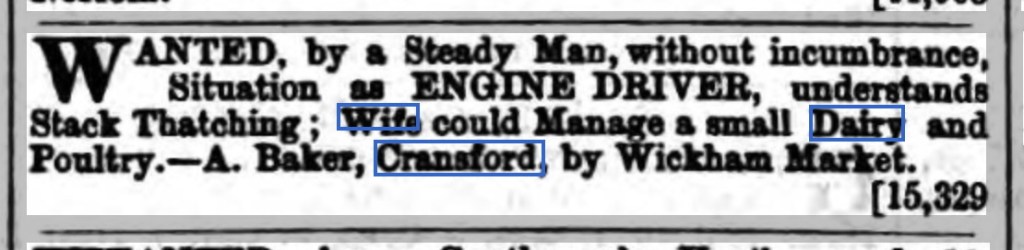
A succession of ‘Wanted’ notices appear in local newspapers looking for men to fill situations vacant, both in Cransford and other local parishes. What makes several of these particularly interesting is that many note that the man’s wife would have her own duties. Below is the example that set me off on this piece of research; it appeared in the Framlingham Weekly News on 25 September 1880, p. 4.

Example 1: Framlingham Weekly News, 1880

I believe I have found the couple appointed enumerated in the census taken the following year. While John is noted as ‘farm bailiff 130 acres employ 3 men’, his wife is listed only as ‘wife’ (copied again in the occupation column). 

In 1881, the following advertisement appeared in the Norfolk News (17 September, p3) hoping for an engine driver with a wife that could manage a small dairy and poultry:

Example 2: Norfolk News, 1881

I do not know for sure if this role was filled and by whom. However, married women with occupations were absent from the enumeration books for Cransford in 1891; the wife’s work went unrecorded if the couple were indeed residing there.

Forgive me, but this final example relates to a vacancy in nearby Peasenhall, which I thought was a particularly good advertisement. It was printed in the EADT on 22 August 1891 and underlines again that farm workers’ wives were often expected to muck in (pun intended):

Example 3: EADT, 1891

Joshua Moore lived at Yew Tree Farm in 1891 and 1901. In neither set of enumeration books can you spot a wife with an agricultural occupation listed. In fact (as is a familiar tale to researchers) women in the parish were rarely noted to have any profession or occupation at all

We know women took up informal work because it is recorded in sources like diaries and news reports. For example, in Labour and the Poor: The Rural Districts (Vol. VI), we hear from a woman near Bury St Edmunds who was questioned about her budgeting:

“We never gets pork, except on Sundays, and then my husband is at home. I don’t think about none all the week, and it is no use a thinking about it, if you can’t get it,” said the sharp little woman, resuming her work at making flour sacks, at which she informed me she could “arne,” if she got up before daylight, and worked all day, the remunerating sum of 6d.” 

As such, the evidence for women’s work is hidden from some of the most popular sources we access, and where it is referred to in others, we get only examples, not a comprehensive list. Our job – as always! – is to find the evidence, evaluate it, and apply it to our places.

Does this mean that the census records are wrong?

In Cransford, in agriculture at the very least (there is limited evidence of other trades and callings in the village at the time), the census does not appear to give a comprehensive reflection of the scale, type and variety of women’s work. Does this mean that the enumerators were negligent in their duties, though? No.

In 1841, enumerators were instructed as follows:

“Profession, Trade, Employment, or of Independent Means. – Men, or widows, or single women, having no profession or calling, but living on their means may be inserted as independent, which may be written shortly, thus “Ind”.

The profession, &c., of wives, or of sons or daughters living with their husbands or parents, and assisting them, but not apprenticed or receiving wages, need not be set down.” See Genuki for source.

We have to remember that the census was not taken for our purposes as local historians 150 years later. Made by and for men and copied up by enumerators who were predominantly men, it – and other contemporary records – must be viewed in the context of its creation and purpose in the 19th century.

Just what counts as a ‘Rank, Profession or Occupation’ after 1841?

In 1851, the instructions were more extensive. Where farmers are concerned:

“The term FARMER to be applied only to the occupier of the land, who is to be returned – “Farmer of [317] acres employing [19] labourers;” the number of acres, and of in and out-door labourers, on March 31st, being in all cases inserted. Sons and daughters employed at home or on the farm, may be returned – “Farmer’s Son,” “Farmer’s Daughter”.

In Cransford, two farmers’ daughters were specifically recorded in 1871, and four in 1881. In 1861, the enumerator diligently recorded women as ‘carter’s wife’, ‘rector’s wife’, ‘journeyman’s wife’ against a further 17 women (33 were not written-up as such). The big problem is that we don’t know to what extent these women were involved in their father’s or husband’s occupations or whether they were also undertaking additional informal or casual work. Still, the enumerator may well have had his reasons for choosing to record ‘x wife’ or not.  

“In TRADES the Master is to be distinguished from the Journeyman and Apprentice, thus – (Carpenter – Master employing [6] men)”

On this point, the wives of tradesmen are rather left out. The wife of a blacksmith, for example, would be neither Master, Journeyman, nor Apprentice. If and when her husband died, the enumerator might write down the trade against her name for want of a Master and/or because she had taken the householder’s role (occupying alone or as head of household).

The last paragraph of the list deals with women and children:

“The titles of occupations of ladies who are householders to be entered according to the above Instructions. The occupations of women who are regularly employed from home, or at home, in any but domestic duties to be distinctly recorded. So also of children and young persons.” 

We might expect lots of female occupations, then? Hmmm. Note that enumerators were told to record ‘the occupations of women who are regularly employed‘. This statement has the potential to keep many women’s occupations out of the census records because their work was decidedly irregular. (It is worth noting that many men did not have a steady wage, either. In Suffolk at this time they may have been employed by the week, or even by the day. However, men were perhaps more likely to be identified as an ‘ag lab’ even when not receiving a regular wage: their occupation was their identity as much as their job). Consequently, for decades after 1851, researchers will be familiar with a blank box to the right of a married woman’s name in the enumeration books. 

Life as the wife of an agricultural labourer in the 19th century was tough – regardless of any additional duties beyond the house, children, and perhaps a vegetable patch and a pig. Making ends meet was an unrelenting struggle for vast numbers of labouring families trying to keep themselves and their children warm and fed, especially if they had a large young family that could not yet contribute to the family pot. 

It is purely logical that women would have sought ways to add to the family’s income, whether that be through assisting in their husband’s trade or business, farm work, laundry, piece work, domestic service or the like. But their employment could be casual, seasonal, informal or taken as and when available; interrupted by childbirth, sick nursing and other responsibilities, perhaps with blurred lines between ‘domestic duties’ and ‘domestic service’. The census was deliberately timed not to coincide with the harvest when many women might have taken on agricultural work. Wives might earn 5s a week in 1840s Suffolk if they were lucky (significantly less than their male counterparts, but enough to make harvest in Cransford ‘the good times’).

Census records do not include all women’s occupations, but they were never meant to.

Does everyone agree that women’s occupations are not reliably recorded?

No, although it’s more a debate about how reliable they are in various places and circumstances rather than a yes or no question. 

There is, as one would expect, to-ing and fro-ing about just how far we should trust the picture offered by the census in as far as women’s occupations are concerned. Some argue that there are exceptions to the rule and that, for example, married women doing factory work in Lancashire may be better recorded than might be expected when compared to married women in rural areas. 

Others in my twitter replies mentioned under-recording in their own places relative to working on the canals and women in small scale business and enterprise, encompassing everything from boarding houses to midwifery, sporting business to beer making. My gratitude to all that replied with their experiences.

Conclusion and further reading

The question I posed at the beginning was: are the census returns of 1841-1881 for England and Wales a reliable source for studying the work of women in Cransford?

I feel the examples in the post show that it is not reliable if we want to view a comprehensive record of the informal, irregular and seasonal work of the agricultural community in Cransford, especially for the female part of the population – and we don’t know exactly how big an omission this is. However, over the years this post covers, the census records do begin to show an expansion in more formal roles with regular wages. If we keep these things in mind, we can view the records in a more objective and focused way.

I prepared this blog for #OnePlaceWomen, the One-Place Studies blogging prompt for March 2021, tying into Women’s History Month, but I think the theme is important all year round. I couldn’t help but notice that even the 2021 census only wanted us to record the job we spent most hours doing. I will go down in history as a Marketing Manager, not a Qualified Genealogist. In these days where so many of us – and perhaps particularly women – have a ‘portfolio’ career, still doing multiple flexible and part-time roles to fit around children and expensive childcare (even besides the pandemic!), the most recent census won’t answer the questions of researchers in a century’s time, either…

I hope my thoughts and sources have raised questions about interpreting the census enumeration books, particularly in their reflection of women’s roles. I’d be interested to hear your insights below.

For further reading, see:

  • Higgs, E., Wilkinson, A. (2016) Women, Occupations and Work in the Victorian Censuses Revisited. History Workshop Journal, 81 (1), 17–38. https://doi.org/10.1093/hwj/dbw001
  • Mackay, A., Brooks, S. (2019) The Morning Chronicle’s Labour and the Poor, Volume VI: The Rural Districts, 271-292.
  • You, X. (2020). Working with Husband? “Occupation’s Wife” and Married Women’s Employment in the Censuses in England and Wales between 1851 and 1911. Social Science History, 44(4), 585-613. doi:10.1017/ssh.2020.32
Categories
Uncategorized

One-Place Tragedy

There is perhaps more talk of tragedy in the press today than at any time in most of our lifetimes. The coronavirus pandemic has brought changes to all of us, and most of us know of someone lost years before their time. Badingham and Cransford residents and former residents have been no exception, and my heart goes out to all affected. 

A theme of #OnePlaceTragedy for February, then, might have seemed a bit much. On the night I did the first research for this piece, it was pretty awful – I’ll be honest – to read about all the horrible things that have happened in my places one after another. Yet it’s hardly surprising that Badingham and Cransford have seen their fair share of nasty accidents, illnesses, drownings, burnings – even murders. The sheer amount of time the places have existed and the thousands of inhabitants that have come and gone during that time makes it inevitable. Covid-19 isn’t even the villages’ first pandemic, of course, although the way this one is playing out has been unique.

Yet if we don’t write about tragedy, we miss a huge number of stories and end up with a lopsided study. As such, I am writing this blog as planned. I don’t want to glorify sad things that have happened, nor do I want to celebrate perpetrators of horrendous acts. However, I do wish my blog to remember the lives of those directly (or indirectly) affected by tragedies – and not just individuals, but their communities. No One-Place Study should look to provide a rose-tinted view of the past; the point is to record research and stories as best we can for the future, not deliberately record just the ‘nice’ bits – a lot of history wasn’t very ‘nice’!

The lady I’m going to write about here was much more than her death, and for that reason, she deserves to be remembered. There is, I’m sure, much more to Annie’s life than her untimely death, but as with many things local history and genealogy, it is the manner in which she passed that brought her the most column inches in the local press and a window into her life. 

With no further ado, I’d like you to meet Annie.

Annie Jemima Backhouse was unusual for Badingham in 1884 for a straightforward reason. She wasn’t born in Suffolk, let alone within five miles of the village. Today that wouldn’t be very unusual, but it made her part of a small minority back then. She was a Yorkshire lass who arrived in the parish in 1883 to teach at the elementary school – now the village hall. (‘Primary’ schools didn’t exist then). I imagine she talked somewhat differently to everyone else; her arrival must have been quite the locals’ discussion point. 

[Was it really so unusual to come from out of county? Analysis of local census returns during the Victorian period shows that almost everybody living in Cransford and Badingham was born reasonably locally. It was usually the preserve of the vicar, preachers, and their respective families (and perhaps the richer landholders), to be born out-of-County at that time.]

What do we know of Annie’s life before she came to Badingham? She was born in Bradford in 1859, the daughter of John, an upholster’s clerk (later Master Upholsterer), and Mary. Annie grew up in Bradford’s West End and later in Manningham, an industrial area known for its mills and back-to-back housing. By 1881, Annie was an Assistant School Mistress, living with her parents, elder sister Julia (Assistant Librarian) and elder brother Arthur (French Polisher). 

What brought her to Badingham? Did she answer an advertisement? Did her uncle (living in Ipswich) influence her ambition or her appointment? Had she held other posts in between? Was she, like her uncle, a member of the Society of Friends (Quakers), and did this help determine her journey to Suffolk? After all, Backhouse is a name with strong connections (although this may be a red herring in Annie’s case). All of these questions and more arise, and perhaps somebody else reading this blog will already have the answers. For now, I will be honest and say that I do not. I would love to get my hands on some more records, but for now, the archives remain closed, and the material I’d like to look at isn’t yet digitised. [eg TNA: ED21/16305]

For whatever reason, Annie found herself in Badingham. A topic of gossip as the residents of Badingham probably found her, she, in turn, must have viewed the village as vastly different from her home. She had made a significant shift from urban to rural living in a community where perhaps she had no connections at all, a brave thing for a single woman in Victorian England. Yet one thing hadn’t changed: her role as a schoolmistress. 

The 1881 census of Badingham included about 70 scholars. The image below is somewhat later than this but nevertheless gives an idea of the school’s size and the building’s look a couple of decades later. It was a National School built in 1875 for 84 children. By 1888 it had an average attendance of 65 (Kelly’s 1888). 

Badingham Elementary School, dated 1915, from my collection of village images. Copyright untraced – possibly EADT.

We know that Annie took up her position in 1883 and that, sadly, she did not hold it for long. This post is, after all, a blog about a tragedy. Much of the information contained in these paragraphs comes from newspaper reports in local newspapers (including the Ipswich Journal, Framlingham Weekly News and Norfolk Chronicle) following her untimely death on 3 March 1884 at the age of just 24.

Monday, 17 December perhaps started as any non-Sunday in Victorian Badingham. It was most likely cold, and Annie would have been grateful for the roaring fire in the schoolroom. Relatively new at the school – having been in post only a few weeks – Annie worked through the morning and, we can imagine, had some lunch after that. But the afternoon would bring horror. At about 2 pm that afternoon, she stood, as usual, marking the register – with her back to the fireplace. 

“Governess, you are on fire!” came the call from one of the boys in her class, a lad of 10 or 11 called Charles Smith. Such, we learn from the inquest. 

We can only imagine the panic that ensued.  

Annie ran first to the Assistant Governess, Miss Short. Unfortunately, according to the inquest evidence, Miss Short was too frightened to render any help. Another newspaper report notes the same for the school monitor, Amy Rose (who was but 13 years old or thereabouts). The newspaper stories are not identical, but it seems that both probably ran into the road to seek help. Luckily Low Street was (and remains) one of the more populated roads in the village, but that was not to be of much immediate use to Annie.  

As others cried for help, Annie ran to some cottages near the school (I suspect these include the ones pictured beyond the school in the image above). If the newspapers are correct, both doors were closed on her by their occupants, who were ‘fearful and frightened’. 

Poor Annie next fled to Mrs Rebecca Newson’s house, where, one paper reported, ‘she caught hold of the palisading in front of the house, and stood there in flames’. Mrs Newson’s son happened to have been one of the boys from the school, and he had run home to tell his mother what had happened (a good candidate is Alfred William Newson, who would have been about 11, but he also had a younger brother, Frederick Harry, who’d have been about 7).

Rebecca, unlike her neighbours, leapt to action, dragged out a rug and ran straight for Annie. 

Again, the write-ups differ slightly in their details. However, it seems Annie was running along the road towards Rebecca and her palisade fence (also pictured) as that lady dashed from her sitting room with her rug. When they met, Rebecca ‘enveloped’ Annie in the carpet. Together with some other neighbours that came onto the scene, the community managed to extinguish the flames, but it took as long as half an hour to put them out entirely. 

Regretfully, the damage was done. Annie had been ‘fearfully burned’. 

Annie was taken back to the school and then on to Rectory Farm. Dr George E Jeafferson, a doctor and surgeon based on the Market Hill in Framlingham, was called to attend her. He continued to do so for the period between her accident and her death – well over two months. According to him, she had ‘suffered a complete loss of skin from the buttocks to the ankles’, and her ultimate cause of death was ‘exhaustion in consequence of the burns’. It must have been horrifyingly painful to linger with such terrible burns.

My modern-day medical expert suggests that having survived the initial shock and fluid loss, the most significant risk to Annie’s life from her burns was the ever-present chance of infection. Butter or fat would not have cured her burns, and there were, of course, no antibiotics. At best, she may have had some pain relief in the form of laudanum, but it must have been terrible, however bravely she bore the results of her ordeal.

The Jury brought in a verdict of Accidental Death at an Inquest held at Rectory Farmhouse on Wednesday, 5 March 1884. Annie’s body was laid to rest in the churchyard at St John the Baptist Church in Badingham two days later. 

It seems that once the flames were out, Annie was shown great kindness and sympathy by the parishioners. After the inquest, the Framlingham Weekly News published her father’s and uncle’s (Rev. S. Collinson, of Ipswich) ‘special and heartfelt thanks to the Rector, and the parishioners in general, for the very great sympathy shown to deceased in her period of sufferings, by many kindly acts and presents to her.’

As we have seen, Rebecca Newson, wife of Badingham’s carpenter, Cornelius, had the presence of mind and calm in a crisis that makes us wonder what might have happened had she lived closest to the school. Through this blog, Rebecca’s actions can be remembered, along with the other community members that tried to help and the kindnesses shown by even more of the village as Annie suffered.

The story leads us to ask whether Annie’s cause of death was unusual. It probably comes as no surprise to many readers that women’s clothing in the 19th Century could be frighteningly flammable. I wrote a blog about it on my personal website back in 2016, but that post focused on celluloid and its accompanying dangers. Unfortunately, burning to death or dying as a result of burns was much less unusual at a time when candles, oil lamps and open fires were the norm for heating and lighting. This risk was especially real for women, who wore clothes with more fabric and more width than their male counterparts.

We do not know precisely what Annie was wearing, but it was almost certainly a long flowing dress. While the widest of crinolines had gone out of fashion by the later years of the 1800s, the fabrics used – even in less showy clothes perhaps worn by school mistresses – still posed a risk. There was still plenty of material to catch fire in a pleated skirt, even in a narrower style of dress than was popular earlier in the century. 

The Ipswich Journal led with a more damning introduction than the other papers when reporting the inquest: ‘The fashion and its results – no guard’. The writers and editor evidently frowned upon the prevailing women’s fashions (not much has changed there, some might argue). 

Is it possible that Annie had a heavily decorated outfit, a particularly full pleated skirt or perhaps even a small bustle? By the time of this Badingham tragedy, women’s fashion was shifting towards fullness in the back of the dress, the same part which caught fire in her case. Multiple layers would have made it more difficult to extinguish the flames. 

For me, the ‘no guard’ part stands out. The same paper noted that a fireguard had been supplied to the school since the accident. A simple action that might have prevented the tragedy in the first place, or at least reduced its likelihood.

Whatever she was wearing, Annie was one of thousands of women in Victorian England who died from burns; a number exacerbated not just by the circumstances in which they lived but by the very clothes they wore. 

Next time I’m home, I will seek Annie in the churchyard and pay my respects. I admire her bravery, heading to Suffolk to teach such a long way from her family, and hope one day to learn more about her life before tragedy struck.

References

1881 Census, England and Wales, Badingham (various entries)
Norfolk Chronicle, 8 March 1884, BADINGHAM, Page 6
Ipswich Journal, 8 March 1884, BADINGHAM, Page 5
Framlingham Weekly News, 8 March 1884, BADINGHAM, Page 4

Categories
Uncategorized

One-Place Landmarks

This month’s blogging prompt from the Society of One-Place Studies is One-Place Landmarks. Or rather, #OnePlaceLandmarks.

Where to start, I wondered. It may be a cliche, but here goes, anyhow:

Landmark. “An object or feature of a landscape or town that is easily seen and recognised from a distance, especially one that enables someone to establish their location.”

Thank you, Google, but this definition being as it may, I think there is an additional dimension to landmarks that is somewhat more personal and emotive – and perhaps less easily framed. As such, this blog isn’t going to list all the more obvious landmarks in my places: the churches, chapels, rivers, village signs, pubs, manor houses, former schools, industrial sites and ancient buildings. All of those and more could be argued landmarks; some for mere decades, others centuries. Apologies if that’s what you came here hoping for, but I daresay all will appear elsewhere in my blog in due course.

For me, the status of landmark includes elements of people, memory and community – for better or worse. What follows is a round-up of some of the landmarks that have left enduring etchings in my brain. If you will allow, this blog’s definition of a One-Place Landmark is rather more as follows:

“An object or feature of a landscape or town that is remembered and recognised in situ or in memories or archives, especially one that emotes a feeling of connection to an event, a place, a community, or all three.”

Long-time readers will know that I grew up in Badingham. Despite getting on for a year of lockdown and just a solitary visit in this past year, I can of course still conjure up plenty of images of the village, as well as neighbouring Cransford, in my mind. Here are a few of them, some that are unlikely to be ‘landmarks’ to many, but others that have been landmarks to thousands.

Let me start with – of all things – the bus stop; not just any village bus stop, but the one on the corner of Mill Road and Low Street. Mum calls it Aunt Bessie’s corner because it’s outside what was once Aunt Bessie’s house. I never knew Bessie Stanley, but she can still be located in Badingham today under a cross right outside the church porch: my landmark, was once her landmark.

The bus stop was a place I walked to and from for most of my primary and secondary school life. I can remember warm days, snowy days, gloomy days, and the days we walked there across Auntie Muriel’s garden (one of several non-biological aunts and uncles I had in the village) because May Gurney had dug up Low Street and left it that way…for months. Very clearly, I also remember the day that Dad gave me a double-thumbs-up as I looked out of the bus window, him having that day won a case in small claims court. Family events, given a One-Place backdrop.

For me, the path ‘up the fields’ is a landmark, if not a very geographically specific one, being a ‘route’. We walked the dogs across sleeper bridges and along field edges to the pond and woodland at the top, from whence you could see Dennington. Come crisp frosty days, parched sun-bleached days or sad and lonely teenage angsty days, one or more of us would walk up there accompanied by each of the Labradors I’ve known – each one a family member themselves.

To get ‘up the fields’, you have to cross the River Alde, really rather small here in my place, but, nonetheless, liable to flood its banks occasionally when I was little; a bit of excitement for us kids because it might just mean a day off school and a neighbour spotted in a dinghy. Our house sat on a hill out of the water’s way, giving us a bird’s eye view across the river to the fields in front.

Our house and garden offered a place to observe the passing of the seasons; the combine in the field at harvest time and the beautiful colour of the trees beyond during autumn. Of course, the house is perhaps the most important landmark of all in my collection of One-Place landmarks: journey’s end and ‘home’ even now.

What else might I include? There’s the field in front of what was once a Rectory (Badingham has several!). For many years Dad and his friend set off the village fireworks and managed the bonfire arrangements, and the field was the venue. The family involvement meant many trips back and forth to check on arrangements, set up tents and ropes, distribute sale-or-return soft drinks and later eat burgers and onions from Dot and Rita’s BBQ while watching increasingly large displays as the years went on. Perhaps best of all, the morning after, we’d walk around the fields nearby collecting rocket sticks in the chill of a November morning.

There can be barely anyone that doesn’t think of the village hall as a landmark. Once a school, in my lifetime it was the building that hosted my playschool, and, later, my 18th birthday party when I took to the ‘stage’ (a side room!) to play bass with my Sixth Form band. It was also the site of my one-and-only Brownie meeting (not my thing, it turned out) and the 50th Anniversary of VE Day. It was (and remains, pandemic aside) a key destination for many a village function and meeting.

Like the village hall, it almost goes without saying that The White Horse is a landmark to residents and locals alike, being immediately apparent from the main road. “Where’s Badingham?” “Do you know the pub on the A1120?!” I must admit, though, that I am yet to spend much time there. For me, it doesn’t hold the same kind of memories as other places in the village; once able, it was to Framlingham that my friends and I gathered. I did, however, attend my little brother’s 30th there. That event took place just a few days after I found out I was expecting what would turn out to be my second son: me, a secret, and a pub dinner.

I am just about old enough to remember the old post office and shop next to the church, full of dusty china horses and chocolate I wasn’t allowed. I believe many people have memories of what, to me, was an intriguing and mysterious place – I’d love to hear them in the comments.

The route of my Badingham Echo and Church Magazine round, which I suspect I could still walk today, took in all kinds of heritage buildings. Farmhouses, converted barns, old workhouses, and a more modern landmark, ‘New’ Lea (built when I was a child). It was with a little sadness that I noticed the stables (where I once poo picked and stamped down the muck heap in exchange for £2.50 an hour) were falling into disrepair. This is another of my landmarks. I spent many an hour busy there for the ultimate prize: riding lessons on a beautiful Irish Draught called Morris.

The church, of course, will feature as a landmark in many a place. I remember Dad helping to mend the floor, burying time capsules, playing in the churchyard with my brother while Dad cut the grass around the headstones, rounders in the corner, fundraising to repair a big crack in the wall, and putting up the refreshment tent for flower festivals. For a short time, I even sang in the church choir (apologies to all listeners), and for a slightly longer one was on the readers’ list, attending services occasionally with Mum in my childhood.

What of Cransford, you ask? My early memories involve my Great Grandmother’s bungalow. For most of my childhood Stick Grandma (as we knew her – she had a stick by then, of course) was a resident at a local nursing home, but I remember Mum and Grandma helping to organise her things when she moved. Another landmark in the village for me is the church. It’s where I attended my first funeral – also Stick Grandma’s, as it happens. She is buried next to her husband, Frederick Seggons, who was born and bred in Cransford. He grew up in the Post Office and later lived at Red House Farm.

The Chapel is one of the places Mum took me to show me family graves when I first became interested in my ancestors. ‘Great Nana’ was buried there in her 100th year. Born in Badingham and moving to Poplar Farm in Cransford after her marriage, she brings together my two One-Place Studies with a lifetime.

Coming back to my own landmarks, I would now have to include a gorgeous farmhouse that I am researching in great depth. A happy and welcoming home as well as a working farm it has endured through tragedy, celebration, wars and unrest. It has witnessed births, deaths, romance – and the lives of a string of strong and inspiring women. More on that one day, I hope.

Here’s to our One-Place landmarks. If you know Badingham and Cransford, I’d love to hear your landmarks below…

Categories
Uncategorized

Cransford – 1871

It’s that time again, and I’m pleased to bring you the headlines from the Cransford census of 1871 compared to the preceding schedules in 1861. 

Just like last time, my first headline is that Cransford has shrunk in terms of the population if not the acreage. Many of the 284 individuals here in 1861 have gone – either to the grave or pastures new. The number of people in the parish now stands at just 237, a drop of 16.5% on ten years earlier and 23.3% on twenty years earlier. In the space of a generation, this must have felt like a pretty significant change.  

Households too have dropped, from 70 to 65 and now to 54, with two dwellings standing unoccupied. Are the latter the same two as ten years before? No. Although one could be. Have some cottages gone completely? Perhaps. Or have some houses, previously home to more than one family, become home to fewer residents? Some map and community reconstruction work may suggest the answers.

As is now traditional, it’s time to look at the age headlines. The first thing to say is that for the first time in the compilation of one of these census posts, we have a lopsided age pyramid: where did all the women go? Granted there are only 17 more men than women, but at 46% vs 54%, we could start to find that young men could struggle to find a match (if this pattern is repeated in surrounding areas) – especially as the largest gap is in 11-20-year-olds. It seems many teenage girls/women had left their rural homes for domestic work in the city of London or elsewhere. This in itself is interesting as it’s often assumed that the men left alone for economic opportunity rather than women. 

This ‘gap’ in the women’s list contributes to the mean age of a woman in Cransford in 1871 being 30.7 – significantly higher than the 25 seen in 1861. Men, too, were older on average, with a mean age of 30.4. 

Only four babies (half the number of ten years earlier) appear in the enumeration book. This is part of a more significant reduction in the number of younger members of the community. While those between 0-10 remain the largest proportion of the population, the percentage has fallen from a chunky 33% to just 22%, an almost identical ratio to the 11-20 age group. It rather suggests that couples are choosing to move elsewhere, and their children are not being born in Cransford.

More than half of the village’s women were 30-60 and just over 4 in 10 men. The dent in the pyramid remains between the children and the over 40s, especially in the male half of the pyramid. Is it a stretch to say that until the 1860s men were more likely to seek opportunities in urban areas and now women are doing the same?

Surnames in the community have taken another tumble by the 1871 census, with only 53 in the village, compared to 64 in 1861. This time around, only ten are needed to cover more than half of the inhabitants (14 in 1861). Chilvers, the most common ten years earlier, has surged ahead from 18 to 26 individuals – making them more than 10% of the entire parish.

The top ten names are as follows: Chilvers (26), Robinson (16), Watts (15), Banthorp (13), Barker (11), Crane (11), Eagle (9), Harling (8), Barber (7), and Kerridge (7). Interestingly, the Bakers fall out of the top ten after decades of being towards the top of the table. The Goodchild family disappear altogether before the census. At the same time, the Robinsons are brand new – a small population means a family with many children can immediately find themselves towards the top of the league table. 

Which brings us nicely to the comings and goings over the preceding ten years! 56% of those present in 1861 were gone by 1871 (182 people), leaving 44% (102) to stay put. These are similar proportions to my last post.

So what became of them? Just as in earlier posts, there are a few where I reserve the right to re-assess my conclusions, but here are my numbers as they stand:

  • 30 (at least) died. (16.5%)
  • 95 (52.2%) moved locally. Whole families often move together; most of them seem to remain in agriculture, domestic service or their current occupation for the next census. It is not proving the case that families lived their whole lives in one parish by this time.
  • 44 (24.2%) moved elsewhere in the UK. Almost equal numbers of men and women took this route, the average age of men 23, and women just 15. This time London was dominant, but it’s interesting to see the number of teenage girls working in vicarages and the like around Norfolk and Suffolk. I suspect that Rev Pooley (or his wife) played a part in finding many of the girls ’places’.
  • 13 still need to be pinned down with a bit more certainty!

In previous years much of this movement was balanced by newcomers. By 1871, though, numbers hadn’t broken even for well over a decade. Between 1861 and 1871, 182 left, but only 129 ‘arrived’ (either through birth or migration). As ever, this misses out anyone that came and went again between census years. 

  • 51 (39.5% of my 129) are under ten, so couldn’t have been in the 1861 census, a significantly smaller proportion than the 50+% ten years earlier. The vast majority were born in the village.
  • 38 (29%) are what I have classed ‘new workers’. Fifteen were married. Twelve are ag labs or male farm servants. Eight are farmers; it seems there has been a seachange in the tenant farmer community, perhaps partly due to the arrival of Lord Rendlesham as a significant landowner. The new women workers are mostly domestic servants (eight), with the last two being a milliner and the new schoolmistress. In the male contingent, there is also a gardener, tailor, wheelwright/grocer, two blacksmiths, a carpenter and two apprentices. 
  • 15 of the ‘new workers’ brought a wife with them (12%). Women’s work is often underrecorded. The enumerator lists these women’s occupations as ‘so and so’s wife’ but that doesn’t mean they weren’t economically active.
  • 13 more are family members of the new workers aged over ten years old (10%; the same as ten years earlier).
  • 4 ‘existing’ Cransford men married and brought their new wives home (3%). 
  • 1 Cransford lady brought a husband to the village (quite the rarity!) – very possibly he actually moved in before he met her, though!
  • The final 7 (5%) were widowed mothers and other family members that had moved to be with their families (or were just visiting). (4%). 

In conclusion, by 1871, the slide had become a slump; the parish was also older and less fertile. However, there was work for those that remained, including 52 agricultural labourers (only down from 58) and several tradespeople. No one was recorded as a pauper or out of employment.

The exodus was not yet complete, though. Next time we’ll look at the 1881 census, by which time the population would slump still further, to just 182. Just 79 of those had been in the parish in 1871, and only 25 ag labs remained…