Categories
Census First World War One Hundred Years Ago People

From Badingham to Burton – who were those who followed the barley?

Seasonal work and the winter push

The rhythm of the seasons has always impacted the human race – in more recent millennia, when to plant, when to harvest. In East Anglia, the harvest brought opportunity for employment to thousands of agricultural labourers for centuries. There was winter work, too, but the workhouse loomed larger for many. Stone picking and digging bush drains might be options, but what if wages were higher elsewhere? What if mechanisation was increasingly used for threshing? What if young men and women could see opportunity elsewhere?

For young, strong men with fewer family ties, especially those with intermittent work who were underemployed or unemployed, there were options. We know about the growth of industry in the north, fruit and hops in Kent, the pull of urban areas, but this post is about a place and a period of history we hear less about. Anyone who has spent time perusing the census enumeration books for Badingham and Cransford will have seen a relatively frequent birthplace appearing by 1901 and 1911: Burton upon Trent.

There’s a very good reason why. 

In the late 19th century, several workers from Badingham and Cransford, in common with other ‘Suffolk Jims’, followed the barley. With the harvest out of the way by September, workers could travel the approximately 150 miles to Burton to help with malting the very crop they had gathered. A few months later, they could return home as the barley ripened once again, making the most of the economic opportunities in both places. 

This migration wasn’t always a permanent move, or a population turning its back on a rural way of life. But it was a way for people to avoid parish relief and to enjoy better wages than might be had at home throughout the winter.

For this post, I set out to see just how many of my Badingham and Cransford One-Place constituents had confirmed links to Burton upon Trent. I found far more than I imagined, and I’ve ended up with a significant piece of research. It’s been fascinating to see the micro histories of the people and names we might recognise playing out the macro stories of industrialisation, boom and decline, and the ebb and flow between places.

The people in these stories were connected in multiple ways – they were families, communities, and otherwise economically associated. Their networks are shouting from the documentary record in a way I didn’t expect, but in a way that could easily be missed if we were looking at just the occupants of a house, or the direct line of a family tree. 

My exploration doesn’t pretend to capture everyone who made the journey from Badingham and Cransford to Burton, nor every season they may have spent there. As genealogists, we are schooled in making robust conclusions, but sometimes we need to build a narrative around the ‘why’ to tell a more interesting story that goes beyond names and dates. A census places a person somewhere, but local history suggests why they were there in that place at that time. What follows is necessarily partial, shaped by what I’ve found in the creation of this post. I offer it as a representative collection of case studies, organised chronologically by arrival in Burton and how that maps to the development and later decline of the brewing industry in the town.

I welcome comments from others who have traced similar paths from this part of Suffolk, so that this shared history can continue to grow in this little part of the internet.

Some context and sources

Burton was booming in the late 19th Century, turning out 980,000 barrels of pale ale a year in the mid-1870s vs 70,000 in 1840. Huge names in the industry, such as Bass, Ratcliff & Gretton Ltd and Samuel Allsopp & Sons, needed temporary labour for malting from September to May, fitting nicely outside the months of the home harvest. By the end of the 19th century, Burton had the most extensive beer breweries in the world, supplying as much as a quarter of all the beer in Britain: more than 3,000,000 barrels a year, the brewing of which employed more than half the town’s burgeoning population. This level of production, possible due to a combination of Burton-specific factors, was unique in the UK.

A couple of sources inspired this post. First, appendices from George Ewart Evans’ Where Beards Wag All, which contain lists of East Anglian workers who migrated to Burton, many of them from this area. Second, that most-consulted but endlessly fascinating record collection, the decennial census. There are, it turns out, plenty of people moving between Burton, Badingham and Cransford, identified within census folios simply by dint of their birthplace being different to their home on census night. My subsequent methodology included creating profiles for these men and women, as well as investigating their immediate families, adding plenty of new faces and stories to my online OPS family tree. It must be said that the long-overdue digitisation of Suffolk registers has been a boon in the past couple of weeks, but alas, Badingham’s registers are not yet among them.   

In my initial foray into available sources, I had a lovely surprise. An RQG colleague, Carolyn Alderson, has published her Genealogical Investigation of the Suffolk Seasonal Maltster Migration in 19th Century Burton upon Trent in the RQG journal. Carolyn identifies Henry Edwards Junior, born 1815, as the initial catalyst for the seasonal migration. Henry was a maltster, manure and corn merchant from Woodbridge who saw an enormous opportunity for the Woodbridge area to make additional profit from its barley. Advertising in 1858 for ‘young strong able agricultural labourers’, Henry played his part in encouraging Suffolk-Burton links…and word spread among local people.

I think that ‘spreading of the word’ was vital, and goes a long way to explaining why Suffolk made up such a large proportion of the seasonal labour in Burton. If your employer has openings, and you have family and friends you can recommend, then you send word, or at least, next year when the brewery agent comes to Framlingham Crown, you take them with you. If you made a relatively good living in Burton in 1878 vs clearing ditches on the days the sun shone in 1877, then you return in 1879 – and you bring your younger brother and perhaps even your new wife.

Not yet here for the beer (1841-1861)

The first Badingham and Cransford-born workers in Burton predate the beer boom. It’s important to note that because we’re going back to 1841 here, the date of the census matters. From 1851-1911, the census was taken in late March or early April, but in 1841, it was taken in June. This means that seasonal labourers might have been back in Suffolk and thus missing from the returns taken in Burton that year. However, beer production in Burton was still relatively low.

Our first case studies are all women, not the enterprising ‘strong able agricultural workers’ – and most likely young men – Henry Edwards’ ad might have evoked.

First, we meet Harriett, Badingham-born but in Burton for that first commonly-accessible census, the 1841. This is early, and the census reflects this – Harriet was married to George, who wasn’t a maltster but a shoemaker in both 1841 and 1851.

It’s possible this is Harriet Wood(s), baptised in Badingham in 1794. There is a marriage in London on 20 December 1835 at St Dunstan and All Saints, Stepney, between a widowed George Port and Harriet Wood. For the purposes of this post, this is a circumstantial suggestion, not yet a robust conclusion; that said, the other Harriets baptised in Badingham during a similar period all appear to be accounted for.

Harriet and George seem to have moved to Burton for good; Harriet lived on the market place and died in the town in 1855. As such, Harriet doesn’t fit the narrative of a seasonal worker, or the wife of one. Harriet and George’s lives brought them to the town via London in middle age, but not as a direct consequence of brewing or directly from village life.

Our next women migrants are a pair of sisters, Eliza Ann and Clara Barham, daughters of a Badingham family headed by John and Sarah Barham. Much younger than Harriett, Eliza was baptised on 24 January 1842, and Clara was born in 1855. The Barham family lived near the Bowling Green Inn in 1851. Interestingly, at that time, the head of the household was Sarah, the girls’ mother – a ‘drillman’s wife’. Just where was John? Hold that thought.

Eliza married young, in 1860. Her groom was John Rowe, born in nearby Bramfield. By the time of the 1861 census, the couple were living in Burton where John, too, was a drillman. Eliza had taken six-year-old Clara with her. John was most likely the young, strong, hearty agricultural labouring type that the beer makers were beginning to look for – but just like George Port, he wasn’t a maltster.

Back to John. Sometimes you need to use multiple sites to search census returns to find your man! It turns out there was an earlier Drill Man (sic) in Burton Extra, and sure enough, it was Eliza’s father, John Barham, who was lodging with his brother at a ‘Nail Manufacturer and Beer House Keeper’s’ on Water Road in 1851, while he was missing from Badingham. John’s brother Henry was a drill man too, and over in Stapenhill, there’s yet another Barham, William, with the same trade.

So here’s an example of networks in action, this time, over two generations of the same family – even if it’s not in beer. I think the Barham family were all connected to seed drills – Smyths, which was to become world famous, was based in Peasenhall, busily creating new generations of seed drills right next door to Badingham. Men like the Barhams, many of them from the Peasenhall area, were taking them out into the world, earning money as skilled contractors who could sow faster and more consistently with a new drill than by hand.

I wonder whether, while this Badingham-Burton connection is for a different trade, it nonetheless started to build bonds between the two places. Growing grain naturally leads to malting grain, and the first Barham drillmen would have met landlords and scoped opportunities. Theirs was a big family in a small community back home and they would have returned to Suffolk with intel to share. It’s perhaps telling that in Where Beards Wag All, yet another Barham appears on the Bass, Ratfliff & Gretton Ltd list for the 1926/7 season, indicating that the connection may have stretched and adapted over another generation or two.

The next question becomes whether Eliza and Clara remained in Burton permanently. The answer is no. On every other census, John and Eliza were living locally: Peasenhall, Rendham, and finally Derneford Hall and then Pound Farm at Sweffling, where John rose to become Farm Bailiff. Those early days as a contractor bought him experience and a roof over his head before he could secure better employment at home. Eliza and John, by 1911, were parents of ten surviving children (from a total of eleven); this is a Badingham-Burton family that likely has many descendants today. Clara, too, was a short-term resident of Burton. She later married Frederic Button Roe (sic, no w this time) and lived in Cransford, Peasenhall, and Horham.

When moving to malt became an intentional choice (1870s-1880s)

The railway branch line at Framlingham opened on 1 June 1859, joining the town to the East Suffolk Line just north of Wickham Market at Campsea Ashe. For those looking for employment, this might have made the journey to Burton – and the decision to go – a little easier. The expansion of the railway network certainly boosted Burton’s ability to distribute ale and scale production to meet the increased demand. That increased demand meant more workers, and deliberate migration specifically to malt barley.

Our next case study was living a few doors down from the Barhams in 1861. I don’t think it’s a stretch to imagine Burton being a topic of conversation at the bar at the Bowling Green Inn. Perhaps Arthur Goodchild was enjoying a pint one evening in the mid-1870s, bemoaning his winter prospects, when old man Barham told him there was a good living to be made in malting.

Arthur Goodchild was baptised in Badingham in 1858, and, like so many others in this post, the son of an agricultural labourer. It’s always important to stress that the census is taken only once every ten years, but there is so far no reason to believe that Arthur didn’t spend his childhood in the village between censuses. When he was about 18, he married Rosanna Whincop from neighbouring Peasenhall. Arthur and Rosanna must have left for Burton soon after their marriage because by the time the 1881 census rolled around, they already had two children born in Burton. Maybe Arthur had already been in Burton for a winter season or two before his marriage. Unlike those we’ve met so far, Arthur appeared on the census as a maltster – our first documented.

Networks are again in action here, not just because his neighbours had already been finding work in Burton, but because Arthur himself had already got a lodger – his younger brother John, who didn’t show in the initial searches as his birthplace is noted as ‘Baddington’ (near enough!). For John, his migration to Burton was just the start. While I haven’t researched him in any depth just yet, it looks like he headed to Penge and then Hammersmith before ultimately emigrating to Australia (all while sporting a very handsome moustache!).

For Arthur and Rosanna, it looks like Burton became their home for several years. Again, while we have to remember that the census is a snapshot of one evening, all five of the children with them in 1891 were born in the town, and Rosanna’s widowed mother, Priscilla, was also living with them in Burton, along with a new lodger learning the malting trade from Arthur. The family setup suggests rather more permanence than if Arthur were simply lodging somewhere. By 1891, with brewing reaching its peak, there would definitely have been work to support a whole extended family year-round. What’s more, experienced maltsters hosting lodgers ensured a reliable, sustainable source of new labour for the breweries. That said, the connection with Suffolk remained strong; by 1895, Arthur was back. Sadly, we know this from his death record. He was just 37. Arthur was laid to rest where it all began, in Badingham, on 18 June 1895.

For Rosanna, the future remained Burton, even without Arthur. In 1901, she was working as a charwoman there, supporting her children as a second generation in the town. It was a similar picture in 1911, by which time Herbert and Bertie had followed their father into the trade, and in 1921, when she headed a multigenerational household of coopers and wood turners, including grandchildren. Rosanna never remarried. She died in Burton in 1928.

There is another man from Badingham who first appears in Burton in the 1891 census. This chap is Robert Dunnett, who also appears, as ‘Robert Drumett’, in Appendix One of Where Beards Wag All (‘hired by Bass, Ratcliff & Gretton Ltd for work in Malthouses in Burton-on-Trent, 1890-1891 Season’). Unlike Arthur, we know that Robert was probably, at least initially, a seasonal worker. Robert was among three young maltsters from Suffolk boarding with a family on Waterloo Street on that census night.

Robert had previously lived on eight acres farmed by his father John in Badingham, and came from a large family. We know he came and went from Burton because in 1901 he had returned to Suffolk, living at a property near Stark Naked Farm in Flixton. Robert was at that time a horseman living with a stockman and his family. Without this 1901 record, it might have appeared that Robert had gone to Burton and stayed, because the next we see of him is his marriage to Hephzibah Harriet Bullen back in Burton upon Trent.

Robert’s marriage, taking place in February 1903, would have been during the traditional malting season. Hephzibah was a widow, having previously been married to John Bullen, another East Anglian maltster whom she had married at Stoke Holy Cross in Norfolk before moving to Burton and raising a family. Poor Hephzibah lost Robert and found herself a widow again just a year after their marriage. She later married a third maltster, Tunstall-born Suffolk man Horace Reeve, who worked for Bass Co. It seems Horace and Hephzibah both died in Burton, too. A decision was made, quietly or otherwise, to abandon any seasonal movement and make a permanent life in the town; Horace was still working for Bass in 1921. Hephzibah’s story rather suggests that the men from Norfolk and Suffolk in Burton were part of a smaller community within the whole – was it coincidence that all three of her husbands were from the same area, or evidence that they mixed in similar, smaller, circles? Evans’ recollections might suggest the latter – men in different clothes with different accents to their Staffordshire counterparts, who arrived together on a one-way ticket from their local railway station and stayed together thereafter.

The peak of the pull of the Burton pint (1890s)

By the 1890s, enormous breweries in Burton were well established. Beer was being brewed, yes, but the industrialisation of that process brought with it a whole supporting infrastructure and a growing population. Those people from Badingham and Cransford who first appear in Burton in the 1901 census reflect both brewing and its inherent infrastructure. There is a new diversity to the occupations recorded in the census, and the routes our people take after appearing in Burton. 

It was another family affair for the Bakers. Harriet Baker, daughter of William and Sarah, was baptised in Cransford on 23 December 1866 alongside her cousin, Frederick Ife. Both would find themselves in Burton. Harriet moved for work regularly while she was young. Moving from a cottage near Fiddlers Hall, she became a housemaid in Theberton in 1881 and was promoted to cook at a small temperance hotel called ‘Shaftesbury’ in Colchester by 1891.

Perhaps another domestic role took Harriet to Marchington Woodlands in Staffordshire (west of Burton) by the time of her marriage to Alfred Smith in 1896. Alfred was a Staffordshire man born in Silverdale. The birthplaces of their subsequent children suggest they moved to Branston, rapidly growing into Burton, around 1899. Their address of Clay’s Lane in 1901 places them in 19th-century housing that crept along the main road towards the town centre as the town boomed.

Alfred was a carter for a coal and corn merchant. Both of these commodities were vital to Burton’s breweries in the Victorian era. While corn and barley are of course different, a corn merchant would sell both, so that part is obvious. But coal? It turns out that it took between 31 and 85lb of coal to produce a single barrel of beer, depending on the specific processes and equipment available. According to a paper by Nevile in 1906, the coal wasn’t just required for boiling, but for heating liquor for mashing, providing steam for washing casks, and to provide motive power. Alfred was moving the ingredients for a flourishing, coal-fed, Victorian industry. In this endeavour, he was supported by his wife’s Cransford cousins, who were coal miners and railway engine drivers at Newhall, four miles away.

Then we have William Eagle, a young man born in Cransford in 1872 and raised in Culpho – and another agricultural labourer’s son. William’s father, George, remained working for the Hunt family of Culpho for over half a century, his obituary remembering him as strongly religious and exceptionally capable: ‘a thatcher, engine-driver and farm foreman…particularly expert in sowing artificial manures [and] sowing with both hands, so that he did double the amount of work in a day’. I suspect William was not baptised in the village church at Cransford because his family were Baptists; he was by no means the only non-conformist in the parish by this time – the church baptism register is exceptionally quiet in the early 1870s.

William had left the family home by 1891 and married Agnes Sarah Marven in Hendon, Middlesex in 1898. The pair probably remained in London until shortly before 1901 (their daughter, Agnes, was born in Cricklewood). William was not a maltster, but a railway wagon repairer. So, he didn’t follow the barley directly, but like Alfred Smith, he was a vital part of the brewing industry in another way. Burton could only have exported beer as it did with the help of the railways. Without an efficient transport system to distribute it, beer would have remained a locally produced commodity for the most part, instead of production becoming focused in a small area.

It struck me here that Harriet had been working in a temperance hotel and William grew up in a strongly religious household. We don’t know from these records whether they were teetotal, but could it be significant that they were working on the infrastructure side, not in the breweries directly? Evans’ recorded recollections remember Suffolk’s seasonal maltsters as hardworking and hard drinking, singing and dancing through pub after pub. Was it possible to participate in Burton’s economy without endorsing its drink?

A return to rurality?

We move now beyond the zenith of brewing in Burton. The discovery of ‘Burtonisation’ made it possible for companies outside the town to make water resemble Burton’s. Having had more than thirty large-scale breweries in the late 19th century, seventeen remained in Burton in 1911. While these were still a significant source of employment, the micro again reflects the macro in our Badingham and Cransford case studies – by 1911, we see children born in Burton back in Suffolk.

But before we meet those children, we need to revisit the Smiths and the Eagles from the previous section. Did they stay in Burton, or were they affected by the decline in production and profitability?

First, the Smiths. Harriet and Alfred left, but didn’t travel very far; some of their cousins, the Ifes, did remain. While several of the Smiths’ children were born in Burton, the next census, in 1911, places them in Church Broughton, about ten miles north-west, where Alfred was working on his father’s farm. Perhaps there is truth in the suggestion that the industry was a young man’s game; perhaps his family farm just needed him back as farming crept out of depression, and Burton offered diminishing returns. By 1921, Alfred and Harriet were farming on their own account. Harriet’s father had been noted as a pauper back home in Cransford, labouring on another man’s estate when he could. We can hope Harriet felt her efforts had paid off.

As for the Eagles, the family chose Burton as their permanent home, but it wasn’t without change. The 1911 census finds William, now that much older, as a dental mechanic – a ‘working man’s tooth puller’, potentially making teeth to fit as well. There’s a fascinating article on this called ‘Monty, Bring the Blood Can!…’ by Claire Jones if you’d like to learn more. Clearly, this was an occupation that suited William; he was working for Ernest Street Dentist at 75/6 Horninglow Road in 1921 as well. Meanwhile, his daughter and sister-in-law worked at Bass & Co. and Crosse & Blackwell, respectively. Crosse & Blackwell was in the process of opening a factory in a former WWI machine gun factory at this time, representing a new and diversified industry in town – one that would soon after (but not for long) make the famous Branston pickle. William remained a dental mechanic until he retired, passing away in Burton in 1946.

Back to the Hammond children. Arthur, Albert, Rose and Maud were all born to John and Alice Hammond while John was working in Burton. The family (minus Maud, who was by then a live-in servant at The Red House) was at Stone Cottage, Badingham in 1911. The second youngest, Rose, at ten, was the last child born in Burton. The 1901 census must have caught them not long after they returned to Badingham. The family were living on Carrs Hill, not far from Colston Hall. John Hammond was 40 at that time, working as an ‘ordinary farm labourer’. Arthur, Albert, Maud and Rose have all had ‘Lincolnshire’ Burton replaced for Staffordshire – someone perhaps wasn’t sure where it was! Timings are crucial here. Ethel, their eldest, was born in Badingham in 1892, and Rose, the second youngest, in Burton in 1900. The Hammond family could have lived in Burton for nearly nine years without being caught by a census. Potentially, they made the trip each year, but with every child born in Burton, it may have been rather more permanent.

Further research showed that Alice Hammond’s maiden name was Goodchild. Sure enough, she was Arthur Goodchild’s sister. The Goodchild and Hammond cousins must have been in Burton together, even after Arthur Goodchild died. I haven’t gone out of my way to look for connections between people in this post who were seeking work in Burton, but nonetheless, the associations are shouting at us from the documentary record. It makes sense – but those networks still existed in Badingham, too. As fortunes and opportunities in Burton waned, and a few years after Alice lost her brother, the Hammonds came home to Suffolk. It doesn’t look like any of them ever returned.

Closure and conclusion

There is some evidence of continued seasonal migration, even in 1911. Perhaps this was a return to the seasonal migration of the past as permanent moves became less lucrative. Harry (Henry) Hambling, born in Badingham, along with Frederick Briggs from Laxfield, was lodging with the Bennett family, both working as maltsters in April 1911, just as young men from earlier generations had done. For Harry, Burton was a short-term work opportunity; he was back in Badingham to marry on 9 October 1913.

Harry’s generation was the right age to be called to the trenches. Tragically for the Hamblings, he died from his wounds on 9 December 1917. Harry’s wife Florence (nee Ablett), was left behind with two small boys, Harry and Arthur. We are fortunate to have some surviving records for Harry’s war service. His papers show that, when he signed up, he was living at, of all places, Stark Naked Cottage at Flixton – I don’t think this can be a coincidence. Did Harry meet Robert Dunnett, or did other workers in Flixton influence his choice to work in Burton for a season or two? These were families and communities who knew each other well and shared knowledge and experience. There is (so far) no evidence that Florence and Harry went back to Burton after their marriage. Florence married again in 1921, her groom Arthur Pipe, a farmer from Rumburgh.

Harry was perhaps one of the last Badingham men to head off to Burton for the malt. The war took the same young men who migrated for work from the factories and breweries and sent them to Flanders. The war also brought increased restrictions on the trade of alcohol and reduced pub opening times, as well as creating difficulties in sourcing raw ingredients. By the time the war was over, there was no going back and brewery closures continued. Only five breweries were left by 1950. Nevertheless, Burton still brews plenty of beer today. It’s now home to Molson Coors (brewing Carling, Grolsch and Coors). Microbreweries have also seen a resurgence, and are in some cases occupying older brewer premises, see, for example, the Burton Bridge Brewery.

Harry’s story brings the arc of Badingham and Cransford men in Burton to a close. He is a last echo of patterns established over the course of fifty years. There is more work that could be done here to extend the narrative. For example, extending the research to Framlingham, another of my favourite places, quickly finds teenagers Isaac Neeve, Henry Eade, James Walling, George Smith, Herbert Whightman (sic), and Frederick Nesling as potential case studies. Herbert and George were two of no less than six young men from the area lodging in the same house in 1901 – Thomas Flatt (Burgate), Frederick Borrett (Woodbridge), Frederick Bloomfield and Tom Thorpe (both Saxtead) being the others. Similarly to Badingham, by 1911, a significant number of children born in Burton were back in Framlingham.

Badingham-Burton migration is a story of opportunities grasped until such time as the economic and human pull reversed. This New Year, I’ll be raising a glass of IPA and remembering the Badingham and Cransford folk who helped bring it to me.

Endnotes and sources

Full references for each genealogical event can be shared on request. These make for an enormous endnotes section so I have summarised here.

  1. Census returns for England and Wales, 1851–1911.
  2. George Ewart Evans, Where Beards Wag All (London: Faber & Faber, 1970), particularly the appendices listing East Anglian workers migrating seasonally to Burton upon Trent.
  3. Carolyn Alderson, Genealogical Investigation of the Suffolk Seasonal Maltster Migration in 19th Century Burton upon Trent (available: https://www.qualifiedgenealogists.org/ojs/index.php/JGFH/article/view/146/85).
  4. The Historic England Blog, Burton upon Trent: The Beer Capital of England (available: https://heritagecalling.com/2025/03/27/burton-upon-trent-the-beer-capital-of-england/)
  5. Nevile, S. O., 1906, Coal consumption in breweries (available: https://onlinelibrary.wiley.com/doi/pdf/10.1002/j.2050-0416.1906.tb02172.x)
  6. Claire Jones, “Monty, Bring the Blood Can! Pulling Teeth in Working-Class Lancashire, 1900–48”, (available: https://academic.oup.com/tcbh/article/35/2/223/7684985)
  7. Parish registers, civil registration records, and local burial records for Badingham, Cransford, and surrounding Suffolk parishes
  8. Boak, J. & Bailey, R., “From Suffolk to Burton in search of work, c.1880–1931”, Boak & Bailey’s Beer Blog (2019) (available: https://boakandbailey.com/2019/07/suffolk-burton-migration-brewing/)
  9. Brown, Pete, Hops and Glory: One Man’s Search for the Meaning of Beer (London: Pan Macmillan, 2009). [While not directly used in the creation of this post, this is a book recommendation – I very much enjoyed it!]
Categories
First World War One Hundred Years Ago People Uncategorized

Bessie Carley: Badingham’s Decorated TFNS Assistant Matron

It was in March 2017 that I first wrote about Miss Bessie Carley. She grew up in Badingham and had a varied nursing career in several English institutions before war broke out. After the declaration of war, she worked at the First Eastern in Cambridge and the 55th General in France, becoming decorated with both the Royal Red Cross (2nd Class) for service at home and, two years later, the Royal Red Cross (1st Class), for service abroad. To receive both was, and I quote, ‘pretty impressive’!

Bessie has intrigued me ever since I ‘discovered’ her, but it hasn’t been until recently that I’ve been able to sit down and research her life in a little more detail. And I’m so glad that I did. What follows is the story so far, but I’m sure there’s more to tell. I’d love to hear more in the comments.

Bessie is nothing short of an inspiration. A remarkable woman, through hard work and determination, Bessie rose right up to Matron by the age of 38. She probably nursed at least one of her parents before training formally, and went on to be ‘intensely useful’ for the rest of her life, even, according to the local newspaper, working under bombardment.[i] The legacy she leaves is one of which her family (and her ‘place’, Badingham) can be very proud. 

Two things happened earlier this year that reawakened my interest in Bessie after three years of spending most of my free time with my two consecutive babies. Firstly, a twitter contact was tweeting about nursing records that Bessie most likely appeared in – and it turned out that she did.[ii] Now, having a copy, I know that those records are full of moving additional details beyond her war service, including letters from her family (more on that later). I unwittingly received the documents almost one hundred years to the day since Bessie’s death. 

Secondly, and almost concurrently, I received an email from a gentleman who had letters written by Bessie in his possession. Bessie had nursed Chris Payne’s grandfather, Sergeant Charlie Payne, in his final days, and had written to his family on more than one occasion. Again, these letters give us additional insight into Bessie’s life. 

The next task seemed to be whether we could unite all of these records with Bessie’s modern-day family, and, potentially, find a photograph of her to put a face to her name. 

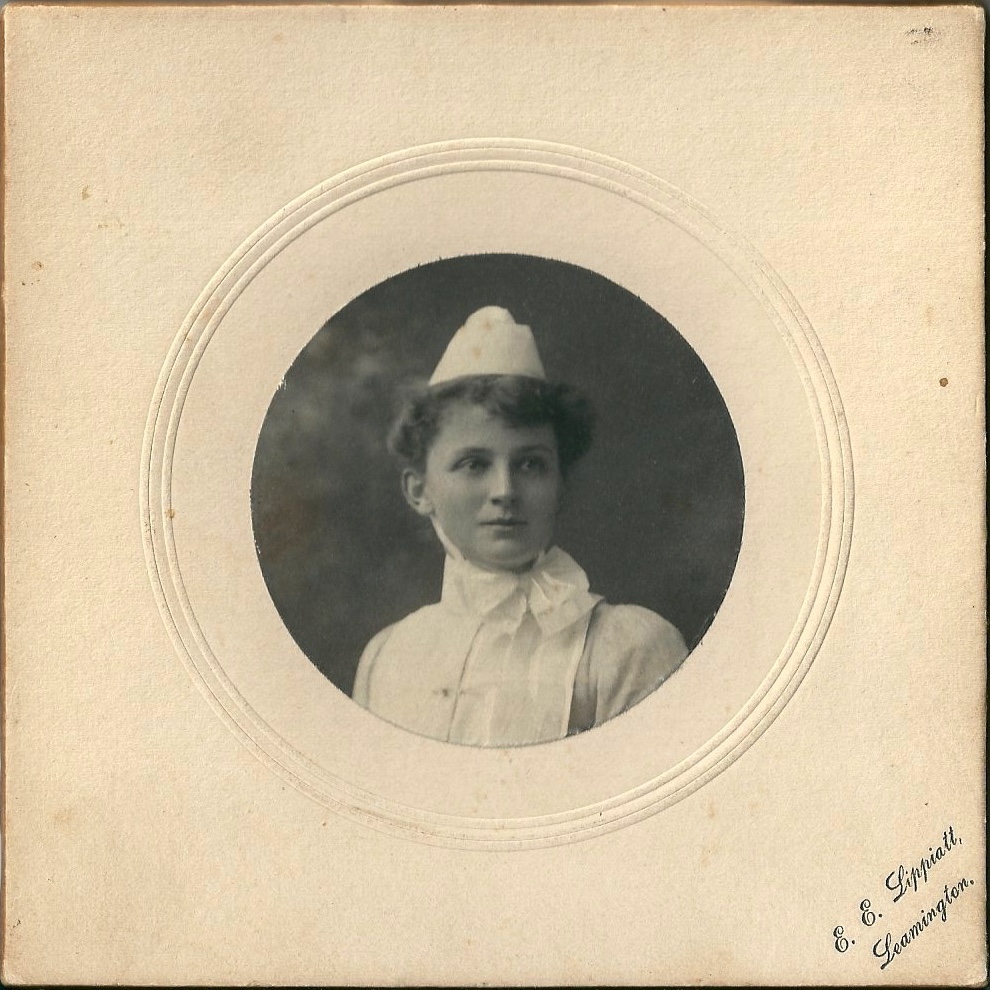
I am delighted to say that we were able to do just that, and so much more. Bessie’s Great Nephew has kindly allowed me to share images of some family archives. So, without further ado, here she is:

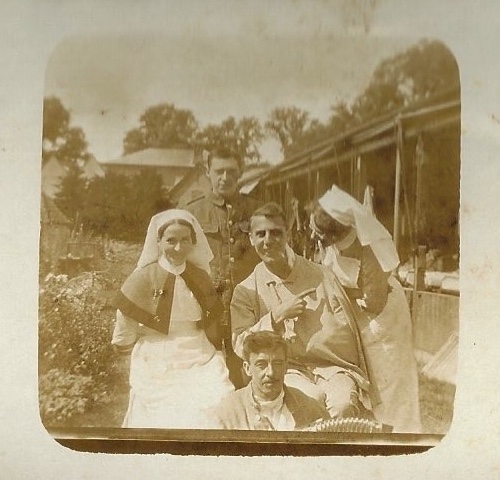
Bessie Carley, probably taken during her time at Warneford Hospital.
Another photograph of Bessie. With grateful thanks to her family.

Please note these photographs are shared here with the permission of Bessie’s family. Please do not re-use them without speaking to them first; I am happy to pass on your details to them.

Bessie’s early life

Bessie was the seventh child of eleven registered by her parents John Carley and Jane Adeline Carley (nee Mills; her first names have, on occasion, been noted as Jeanie and Adelaide).[iii] Bessie was born at the Red House in Badingham, the family farm, which amounted to 172 acres in 1881.[iv] Three elder sisters and an elder brother were living at the time of her birth; two more brothers had sadly died young.[v] Three additional brothers and a sister would arrive after Bessie came along and before the next census.[vi]

Seven of the surviving nine Carley children were still at the Red House in 1891 with their parents and two servants, one of whom was 16-year-old Elizabeth Baldry, my Great Great Grandmother.[vii] Eldest sister Ellen was a teacher (still at home) while Bessie’s eldest living brother was boarding at Framlingham College with the sons of many other local farmers.[viii] Janet, also missing, was staying with her aunt and uncle at their grocer’s shop on the High Street in Hemel Hempstead.[ix]  

It was to be Bessie’s father’s last census. He died at the Red House just a few months later, on 29 January 1892, aged 53.[x] John had for many years sat on the Board of Guardians for Hoxne and ‘endeared himself to a large circle of friends by his genial nature and sterling worth’. He was important to the parish and valuable to the community, and as such his funeral received several column inches in the East Anglian Daily Times.[xi]  

Interestingly for Bessie’s story, this meant that she grew up with her father involved in the treatment of the poor locally. There are other relevant clues in her father’s obituary too. We know, for example, that according to the newspaper, he had ‘for many years [been in] delicate health’ and had ‘fallen at last a victim to the prevailing epidemic’.[xii] It seems most likely that the epidemic in question was the ‘Russian’ or ‘Asiatic’ Flu pandemic, which was widely reported in the local news at the time. It came in several waves, the third occurring from approximately November 1891-June 1892.[xiii] 

‘Notwithstanding the inclemency of the weather, and the prevailing sickness (which prevented all the female members of his family attending the funeral) a large number of relatives and friends assembled to pay the last tribute of respect to the memory of an old friend’.[xiv] Did Bessie herself succumb? Her brother attended, so I am not sure her absence can be entirely explained by the family isolating. At the time of writing, the parallels with today’s funerals without family members in attendance are striking.

By the age of 11, therefore, Bessie had experienced the influence of a pandemic on her own family. Potentially she had played a part in nursing her father, or at least observed others doing so. And there was more to come.

On New Year’s Day, 1899, her mother sadly died too, again at the family home. ‘The deceased lady had been in somewhat delicate health for some time past, but it was not until a few days before death that she was compelled to take to her bed’.[xv] Bessie and her eight surviving siblings now found themselves without either parent, and this time around, at the age of 18, we might imagine Bessie had done more of the nursing, especially as at least one of her elder sisters had already left home.   

The family at the Red House was much reduced by 1901.[xvi] It would be a very unusual circumstance to find nine siblings happily sharing a property after their parents’ death, and it was no different for the Carley family. As one might expect for the time, Richard, the eldest son, was enumerated as the head of the household, farming the land. The sister immediately before Bessie, Annie, was acting as the housekeeper, and the youngest child, Robert, was still at home, being just ten. 

Where had the other children gone? Ellen was already married and had taken her younger sister, Janet, as Governess for her children in Middlesex.[xvii] Agnes, too, was a Governess, this time for the Brown family in Melton.[xviii] The boys, John and Samuel, being younger than Bessie and still of school age, were boarding at Beccles College.[xix] They would later strike out for Australia.[xx] As for Bessie, her nursing career had begun…

Bessie’s early career

Perhaps being a governess or housekeeper like her sisters wasn’t for her and nursing presented itself as a good alternative option for a single woman in want of an occupation. Perhaps she had known she wanted to be a nurse for some time. Either way, the 1901 census finds Bessie as the youngest nurse (just 20) living in at The Warneford Hospital.[xxi] The hospital opened in 1832 and closed in 1993, and records are deposited at Warwickshire County Record Office.[xxii] It was at Warneford that Bessie completed her training. She left home at a time when more and more hospitals were establishing training schools, and probably attended lectures as well as learning ‘on the job’. It may be that her work on the wards covered her training, bed and board for her first years in the profession. This photograph shows nurses on the Hitcham Ward at the hospital in the 1900s, and there are several others on the site for interested readers, although generally from after Bessie’s time. 

The first image in this blog likely coincides with Bessie’s time at Warneford. The photographer was local to Leamington Spa at the turn of the century.[xxiii]

From Warneford, Bessie worked in at least two other institutions. In 1911, the census placed her as a ‘fully trained sick nurse’ living at the Nurses’ Home on Brook Street, Ipswich.[xxiv] It is unclear under what logic the staff were recorded, but Bessie was the first nurse in the list. By 1911 she had more than a decade’s experience under her belt. At the time, the East Suffolk and Ipswich Hospital was at Anglesea Road. Interestingly, staff records are among those held at Suffolk Record Office for the period 1881-1951 – something for another day![xxv] 

First World War – home service

According to the local newspaper, before war broke out, Bessie was in charge at Dovercourt Nursing Home.[xxvi] Her service records, which amount to 77 pages, give details of her wartime career as well as providing touching connections to her family back home in Badingham, where her eldest brother and next of kin, Richard Carley, still lived at Red House Farm.[xxvii]

Her records say that Bessie joined the Territorial Force Nursing Service (TFNS) on 10 August, 1914, just days after Great Britain declared war on Germany. At the time she was a Sister-in-Charge and lived at the ‘Dovercourt Branch of the Ipswich Nurses Home’. There were several hospitals in Dovercourt during the First World War. It is unclear for now at precisely which one Bessie worked. The Borough of Harwich already had an Isolation Hospital and Cottage Hospital before the war, and almost immediately after war was declared it had several more including Dovercourt Military Hospital and The Women’s Suffrage Hospital. For more details of local hospitals, please see here.

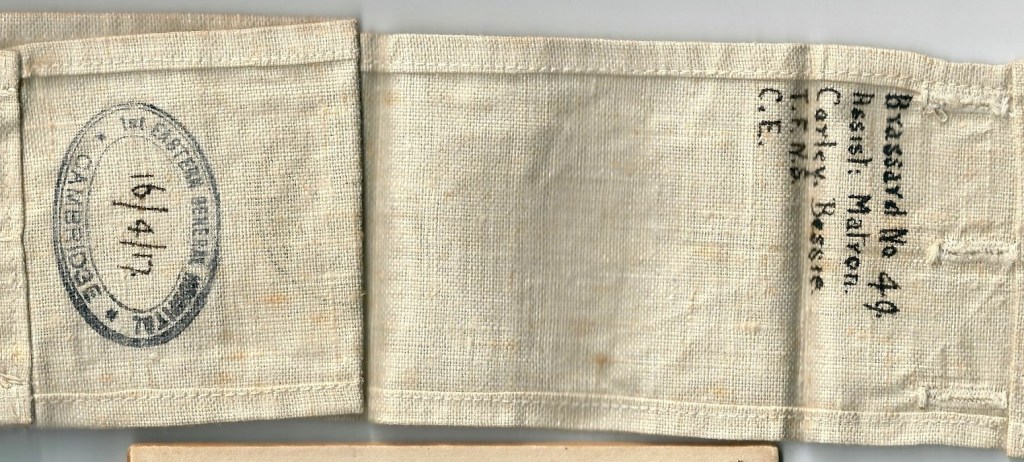
After joining the TFNS, Bessie initially worked at the First Eastern General Hospital at Cambridge, incidentally where my Great Grandfather (and more than 70,000 others) received treatment. The site is now home to the University Library.

Bessie remained at the hospital for more than two years. Her first annual report in August 1915 described her as methodical, hardworking and punctual with a good deal of initiative; ‘her ward has a good tone’. All essential qualities in a Ward Sister. A year later, the same Matron, Annie Macdonald, described her as ‘self-reliant…instructs the Red Cross Workers well and has a good influence on the ward’. It seems she was able to keep her ward – and the men and staff on it – in good order.

There is a fascinating video about the hospital on the University of Cambridge website, narrated by Dr Sarah Baylis. I think I may have spotted Bessie herself in some of the stills within the video; see what you think! 

At its peak, the hospital had 1700 beds, a cinema, post office and other recreational facilities for those well enough to bowl or box. It was, in essence, a small town within a city, but one known for its open-air wards and curative use of direct sunlight, saline baths and massage therapy (Bessie was certainly trained in the latter). Having been mobilised right at the beginning, Bessie would have seen the hospital mushroom in size over the course of ten weeks.

While she was working in Cambridge, her younger brother Samuel signed up for war service from New South Wales, Australia, where he was farming with their brother John (Jack) at Mountain Creek.[xxviii] He would later be posted to France. Her sister Annie, perhaps inspired by Bessie, volunteered with the Red Cross and took on general duties at Easton Park Hospital for a couple of years, just a few miles south of Badingham. The 27-bedroom mansion on the Easton Park estate had been turned into a Red Cross Hospital under the care of Mary (Dowager) Duchess of Hamilton.

Although the First Eastern Hospital was in England, conditions during those first years were not easy. Being open to the elements brought challenges from storms, floods and pests, and the number of wounded being admitted was often overwhelming. It was difficult to blackout the wards and the fear of Zeppelin raids was real. Although commercially-produced postcards were posed showing the staff and patients looking relaxed, they disguised the true nature of nursing under canvas with patients often in great pain and the constant rotation of new admissions. Trained staff were in short supply, and Bessie would have worked on her feet for long hours, probably collapsing into bed exhausted at the end of each shift, ready to do it all again a few hours later.

<p value="<amp-fit-text layout="fixed-height" min-font-size="6" max-font-size="72" height="80">In March 1917, Bessie was decorated by the King at Buckingham Palace with the Royal Red Cross.<a href="//33A27A68-F68D-4499-AC15-70E1338A4C72#_edn29"><sup>[xxix]</sup></a> I wrote in my <a rel="noreferrer noopener" href="https://badingham-and-cransford.co.uk/2017/03/03/100-years-ago-today-decoration-of-bessie-carley/&quot; target="_blank">original blog</a> post that, according to the local newspaper, her portrait appeared in the <em>Sketch</em> and the <em>Mail</em>. Having now performed a search of the <em>Sketch</em> myself and asked a friend to check her access to the <em>Mail</em> archive I remain empty-handed, but I will keep looking.<a href="//33A27A68-F68D-4499-AC15-70E1338A4C72#_edn30"><sup>[xxx]</sup></a>In March 1917, Bessie was decorated by the King at Buckingham Palace with the Royal Red Cross.[xxix] I wrote in my original blog post that, according to the local newspaper, her portrait appeared in the Sketch and the Mail. Having now performed a search of the Sketch myself and asked a friend to check her access to the Mail archive I remain empty-handed, but I will keep looking.[xxx]

The Sketch features several high-society women who selflessly toiled in hospitals during the First World War. Bessie, of course, was not a society lady. She had reached her rank not through her position in the prevailing class structure but through hard slog: scrubbing and caring and cleaning and instructing. While she had been born the daughter of a farmer (and employer) rather than an agricultural labourer, I am sure she was no stranger to hard work, and she was deserving of the honour. 

This photograph of Bessie, supplied by her Great Nephew, may well have been taken at the First Eastern:

First World War – service abroad

Shortly after receiving her RRC (2nd Class), Bessie was promoted from Sister to Assistant Matron of the Eastern General Hospital (No. 55 General) for Active Service overseas.[xxxi] The request was agreed and confirmed in May 1917 with her appointment dating officially from 30 April. According to a memo in her record, the hospital was to have 1040 beds. Bessie was among many staff transferred from the Cambridge hospital to France, leaving the base in Blighty ‘acutely short-staffed’.[xxxii]

No. 55 General was a Base Hospital at Wimereux, a coastal town three miles north of Boulogne. With today’s transport, it is about 90 minutes from Ypres (to the east) and Arras (to the south-east). During the First World War, Wimereux was a critical hospital centre, and it is while Bessie was there that she nursed Chris Payne’s grandfather, Charlie.

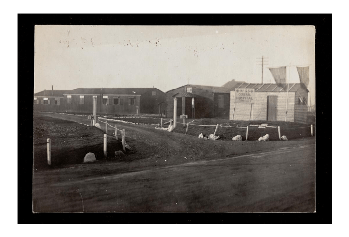
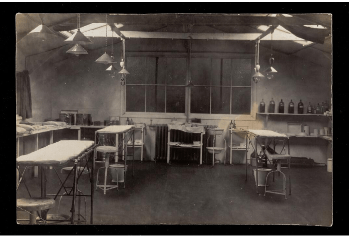
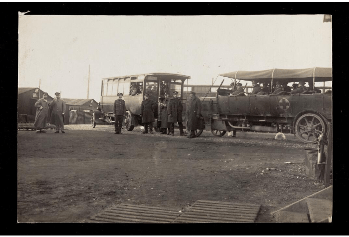
The Wellcome Library has digitised twelve images of No. 55 on its website and has allowed me to share some here on a CC BY NC license.[xxxiii] Full details and the rest of the photos are available at this link.

‘1915 55 General Hosp. BEF’
[No caption on reverse]
‘Convoy arriving. 55 General Hospital. BEF.’

On 17 July 1917, a couple of months after she arrived, Bessie’s Report Form (part of her service record) says that she had good health, good conduct and excellent character; ‘capable, energetic, hardworking. Has plenty of common-sense and is a great help in my work’ remarked her Matron, still Annie Macdonald. 

Armbands from Bessie’s First World War Service

At home, Bessie’s elder sister Annie, who still lived at the Red House, Badingham, died on 29 August.[xxxiv]She was only about a year older than Bessie. Both Bessie and Samuel were noted as being on active service in the funeral report published in the Framlingham Weekly News, Bessie being ‘unable to reach home in time for the funeral’ from ‘a base hospital in France’.[xxxv] 

There must be a great deal more to learn about No. 55 (or ‘the 55th’). Bessie’s service was unbroken, and we know from her record that in January 1919 she was recommended for promotion once again. Her Matron, still Annie Macdonald, who had worked with Bessie from October 1915, first as Sister and later as Assistant Matron, had this to say when recommending her for promotion:

‘She is a well-trained woman interested in all branches of nursing, a good administrator and teacher. She quickly sees important points and her judgement can be relied on. Very even-tempered, tactful, energetic and hardworking, her one desire is to be useful. I find her the greatest help in my work.’ 

In response, the Commanding Officer, Lt Col. Rodink, noted ‘I thoroughly agree with all Matron has said’! Col. Thurston concurred, and the Matron-in-Chief, Emma McCarthy,[xxxvi] described her as ‘A most capable woman, kind, conscientious, reliable and a loyal supporter…came to France 30 April 17’.

It was during her last months at No. 55 that Bessie nursed Charlie Payne, otherwise Sergeant C. F. Payne 235435 of the 2/5 West Ridings.[xxxvii] Charlie was admitted to the hospital dangerously ill with broncho-pneumonia on 6 February 1919.[xxxviii] The hospital was in the midst of the ‘Spanish Flu’ pandemic that swept around the globe in waves from 1918-1920, ultimately killing more people than the war itself. Now a trained nurse under pandemic conditions, it must have brought back pangs of the influenza that most likely killed her father. (Writing about previous pandemics in the midst of another is not lost on me; I do wonder what Bessie might have thought about the response to Covid-19.)

It is a particular privilege to read letters penned in a subject’s own hand. Through a handwritten message, there is a tangible connection to the past and the people that existed in it. For many that have left us no such link exists because it has not survived (or never existed in the first place), but with Bessie, we are lucky. Bessie wrote to Sergeant Payne’s wife twice, and these letters have been treasured by the Payne family ever since, first by Charlie’s wife Ida – who stored them in a black Victorian hatbox – and later by Chris’ father and finally Chris himself. 

According to Bessie’s first letter, of 9 February, Charlie’s condition on admission was ‘most serious…we thought some of it might be due to the journey during this severe weather and that quilts[xxxix] of warmth and treatment would perhaps make a great difference but I regret to say so far he has failed to respond to any treatment’.

She goes on, ‘his breathing still remains as laboured and…his pulse is very feeble. I am so sorry to have to send you this sad report realising all too well the anxious time you will have been passing through ever since he came out here…I can assure you that everything possible will be done for his comfort and towards his recovery – but the next week or so will be most critical and until that is past I dare not give you any definite hope.’

Sadly, Bessie was to write again ten days later with the worst news. ‘It is indeed with sadness that I write to tell you in spite of all possible care and skill your poor husband got gradually weaker and weaker until he passed into his well earned rest at 4.45 pm today. I am sorry to say that I have no message or last wish for you. He slept the greater part of the time and when awake his breathing was too distressed for us to worry him or encourage him to talk’.

The last paragraphs of the letter deal with how any of his ‘treasures’ will be returned (‘we are compelled to send these through official channels’) and the statement that ‘when the first great sorrow is over you will always have the proud satisfaction of knowing that he made the Supreme Sacrifice for his country and as one of the Great War Heroes his name will ever remain sacred’.

I find myself wondering just how many times Bessie wrote to bereaved families and how she felt writing that last. There was not much Bessie would not have seen in a wartime hospital. She was surrounded by the sick and injured, dealing with death every day. Her letters come across to me as very professional. She would have been schooled to be so and was, after all, operating within a highly regimented and hierarchical nursing environment. Her letters are also enduringly honest. She does not sugarcoat or skirt around there being ‘no message or last wish’, but, ultimately, her letters are kind and, I think, genuinely sympathetic and caring. 

My Mum, herself a farmer’s daughter and life-long nurse, once told me to be ‘firm but kind’. Bessie seems to embody that sentiment in these letters. She writes the truth, with no truck for embellishment, but in a way that hopefully would become a lasting comfort to his widow and the four young sons he left behind in England. 

In his emails to me, Chris describes how he discovered the letters, along with some from his grandfather written earlier, among his family’s archives. He believes Charlie’s wife Ida must have found them of value because she always kept hold of them. Chris is writing about his grandfather Charlie on his website and in a forthcoming book.

Charlie and Ida Payne, supplied by Chris Payne. With grateful thanks.

Please contact Chris through his website is you have any queries about the Payne family.

After Bessie’s war service

Following her recommendation, Bessie’s career might have progressed even further. However, her war was nearly over, and she came home on leave in July 1919. While back, she needed treatment for varicose veins and had an operation on the 21st of that month at the Queen Alexandra Military Hospital. It may be the case that prolonged standing during her duties was part of the reason that Bessie’s condition developed this far: a physical response to the constant hard work of being a nurse. The Medical Board reported that her condition predated her service (as far back as 1902) but answered ‘Yes’ to active service conditions having aggravated it.

Her file includes several letters written by Bessie to the Matron-in-Chief, Miss Riddell, in 1919. She seems to have been keen to get back to work as soon as she was passed fit for service again on 9 October, 1919. She wrote to Miss Riddell on that same day to say that she would await her orders, wishing to remain in the Force as long as her service was required. She had missed the original date for the second Medical Board owing to a railway strike. I rather suspect she was frustrated by this as she was champing at the bit to get back to work after six weeks’ sick leave convalescing in Badingham.

Bessie was demobilised from the TFNS on 14 October, 1919, days after the Medical Board report about surgery on her legs, although the reason given was a reduction in staffing. She had unbroken service of more than five years. There was no vacancy at any territorial unit as there was a significant reduction in staffing taking place.

Miss Riddell had already given Bessie a glowing reference to copy to prospective employers in June that year, ready for her to send wherever she wished to apply after the war. The evidence suggests that Bessie was already looking at civil posts in Spring 1919, knowing her period of war service was coming to an end. In her letter requesting a recommendation, Bessie noted that she had been advised to ‘write to the College of Nursing and also to my old training school re a future appointment as [I] shall have to continue nursing’. 

Bessie wasn’t, as we have seen, a ‘society’ nurse. For her, nursing was not something to pick up and put down again after wartime, being able to fall back on an independent income. Instead, it was a vocation and a career, a salary and profession. Perhaps she might even have said nursing was her life’s purpose. 

When writing to Miss Riddell, she noted that she had answered an advertisement to a post as Assistant Matron at Isleworth Infirmary. She said in a letter that she would ‘very much like this post but feel my application is too quaint – with no testimonials, photograph or anything’. She had apparently been assured that she could be released early from service rather than waiting for demobilisation if she ‘succeeded in getting anything nice’. She asked for advice ‘if you are not too frantically busy’ and wondered whether Dame Sidney Browne (Matron-in-Chief of the TFNS and later the first President of the College of Nursing) liked a personal letter ‘stating we have given her name for a reference?’ 

The gist of Miss Riddell’s reference is similar to statements already quoted, stressing Bessie’s good judgement, hard work and energy. 

‘She is of the greatest assistance as Assistant Matron, and has been recommended for promotion to a higher rank. She is a reliable and loyal co-worker and maintains discipline. Miss Carley was awarded the Royal Red Cross, 2nd Class, in February 1917, for work in her Home Unit, and the Royal Red Cross, 1st Class, in June 1919, for excellent work and valuable service in France. She is a valuable Member of this Service.’

Sadly, not so very long after peace was declared, on 26 April 1920, Bessie died at the age of just 38, a similar age to her sister Annie, who had died in 1917. Knowing that she worked at the Norfolk and Norwich Hospital and Streatham Nursing Home after the war, it might have been possible that her untimely death was caused by the 1918 ‘Spanish Flu’ pandemic, just as Charlie Payne’s probably was, but the records show otherwise. 

A letter in her file, written on 22 May within the TFNS, says that she died from a cerebral haemorrhage; ‘a record has been made of the cheerful and willing service this member rendered to her Country’.

But it is the letter written shortly after Bessie’s death from her elder sister, Janet, that tugs at the heartstrings the most. I include it here in full, taken from the pages of Bessie’s service record.  

‘Dear Miss Riddell,

Thank you for your very kind letter of sympathy. I think my dear sister’s life was one of intense usefulness – then she was so unselfish, so bright and so inspiring! Her loss leaves – for me – a blank of very great loneliness. Sometimes I feel it would perhaps have been among her wishes – to pass straight on from work here, to the wider work beyond.

With renewed thanks, very sincerely yours,

Janet Carley’

Janet had also written to the authorities a week earlier, bearing the news of his sister’s sudden death at Guy’s Hospital. She said that she died from a cerebral haemorrhage caused by a cerebral tumour that was found to be forming. At the time of her letter, Bessie had received the RRC (2nd Class), but the 1st Class was still due to her, and Janet enquired about other medals that may not yet have been issued, viz; the Victory, Allies and Territorial medals. 

The Framlingham Weekly News ran an article following Bessie’s death entitled ‘Badingham Family’s Sorrow. Death of Miss Bessie Carley at the Zenith of her career’.[xl] 

The piece tells us a little more about her ‘splendid war nursing career’ and recounts that she had recently been appointed Matron at the Streatham Hill Nursing Home. It was there that she had suddenly been taken ill on a Sunday evening, after which she had been taken to Guy’s Hospital where she was seen by ‘a Harley Street Specialist’. 

‘While on duty in France Miss Carley was frequently in the danger zone and was in one of the hospitals at the time of their bombardment by the enemy. She escaped uninjured while the victims of the enemy’s wrath lay around her, but she suffered for a considerable time from shock. After being demobilised in Autumn last she joined the staff of the Norfolk and Norwich Hospital, and just prior to commencing her new duties at Streatham early in April she spent a few days’ holiday at home’.[xli]

The article goes on to detail the attendees at her funeral, among whom was Miss Annie Macdonald, her wartime Matron, who by then was Matron of the Suffolk Convalescent Home. There are no details about the bombardment and how it affected Bessie’s mental and physical health in her service record, but perhaps somebody reading can tell us more about what happened at No. 55 General Hospital. 

Bessie now lies under a CWGC headstone in Badingham churchyard. Just over 100 years have passed since her funeral, and I am glad to have brought some more of her story to light for future researchers; I know I am by no means the only one to have become interested in her story (and indeed those of her colleagues).  

Having nursed thousands of patients and instructed many a trainee, Bessie must have left her mark on a very many lives. I wonder whether, when she was writing her letters to soldiers’ widows, she ever thought that she might one day be considered to be among the ‘Great War Heroes’ of which she wrote? I suspect not. My humble opinion is that she believed she was doing her duty by being useful, and her role was to be so ‘unselfish, bright and inspiring’. 

History and readers can judge, but having delved into her records, I would say that Bessie was no less a hero than anybody else working bravely in those hospitals, and a hero of whom Badingham can be proud to lay claim.


[i] Framlingham Weekly News. Saturday, 1 May 1920. p2.

[ii] War Office. WO 399/10280: Carley, Bessie. 1914-1920. WO 399 – War Office: Directorate of Army Medical Services and Territorial Force: Nursing Service Records, First World War. National Archives, Kew. I regularly refer back to this key record set when I refer to her ‘service record’ or ‘file’.

[iii] Most frequently, these variations occur in local newspapers. GRO and census records tend to be under ‘Jane Adeline’.

[iv] 1881 Census, England and Wales. Badingham, Suffolk. RG 11, ED 2, Piece 1858, Page 1.

[v] By GRO entries: John Carley (1875-1876) and Samuel Green Carley (1876-1880), both names were reused for later sons. Please contact me for further references.

[vi] Happy to share these details but I have not referenced all births and deaths of family members here.

[vii] 1891 Census, England and Wales. Badingham, Suffolk. RG 12, ED 2, Piece 1461, Page 1.

[viii] 1891 Census, England and Wales. Framlingham, Suffolk. RG 12, ED Framlingham College, Piece 1479, Page 7.

[ix] 1891 Census, England and Wales. Hemel Hempstead, Hertfordshire. RG 12, ED 3, Piece 1124, Page 1.

[x] Framlingham Weekly News. Saturday, 6 February 1892. p4.

[xi] East Anglian Daily Times. Monday, 8 February 1892. p5.

[xii] ibid

[xiii] Opinions differ on the number of waves. John’s death certificate has not yet been ordered to confirm this cause of death so we are relying on the newspaper here. Ideally, his death certificate should be ordered for clarity.

[xiv] See 11.

[xv] Framlingham Weekly News. Saturday, 7 January 1899. p4.

[xvi] 1901 Census, England and Wales. Badingham, Suffolk. RG 13, ED 2, Piece 1767, Page 11.

[xvii] 1901 Census, England and Wales. Finchley, Middlesex. RG 13, ED 6, Piece 1234, Page 10.

[xviii] 1901 Census, England and Wales. Melton, Suffolk. RG 13, ED 7, Piece 1785, Page 1.

[xix] 1901 Census, England and Wales. Beccles, Suffolk. RG 13, ED The College, Piece 1799, Page 2.

[xx] Australia, WWI Service Records. Carley, Samuel Green. 1914-1920. SN 6481. Available online: ancestry.co.uk

[xxi] 1901 Census, England and Wales. Leamington Priors, Warwickshire. RG13, ED The Warneford Hospital, Piece 2933, Page 1.

[xxii] See Hospital Records Database, available online: https://www.nationalarchives.gov.uk/hospitalrecords/details.asp?id=726&searchdatabase.x=0&searchdatabase.y=0&hospital=warneford&town=

[xxiii] See Victorian Photography Studios: http://www.hunimex.com/warwick/photogs.html

[xxiv] 1911 Census, England and Wales. Ipswich, Suffolk. RG 14, ED 15, Piece 10813, Page 1. [Note, this record is not indexed on Ancestry. You can browse to it or search for Bessie on TheGenealogist instead.]

[xxv] See Hospital Records Database, available online: https://www.nationalarchives.gov.uk/hospitalrecords/details.asp?id=569&hospital=ipswich&town=&searchdatabase.x=0&searchdatabase.y=0

[xxvi] Framlingham Weekly News. Saturday, 1 May 1920. p2.

[xxvii] War Office. WO 399/10280: Carley, Bessie. 1914-1920. WO 399 – War Office: Directorate of Army Medical Services and Territorial Force: Nursing Service Records, First World War. National Archives, Kew.

[xxviii] Australia, WWI Service Records. Carley, Samuel Green. 1914-1920. SN 6481. Available online: ancestry.co.uk

[xxix] Framlingham Weekly News. Saturday, 10 March 1917. p4.

[xxx] It should be noted that what the Framlingham Weekly News published cannot always be backed up. Although the gist of the reporting is correct, the paper is liable to change the spelling of names or alter minor details, either introducing a variant/error, or perhaps reporting one that was passed to them or something that in the end might not have happened. An example is refering to Bessie as being attached to Queen Alexandra’s Imperial Nursing Service rather than the TNFS. As always with newspapers, read with a pinch of salt!

[xxxi] War Office. WO 399/10280: Carley, Bessie. 1914-1920. WO 399 – War Office: Directorate of Army Medical Services and Territorial Force: Nursing Service Records, First World War. National Archives, Kew.

[xxxii] University of Cambridge. From the Front to the Backs: Story of the First Eastern Hospital. 01 July 2014. https://www.cam.ac.uk/research/news/from-the-front-to-the-backs-story-of-the-first-eastern-hospital

[xxxiii] Army Medical Services Museum, Keogh Barracks, digitised by Wellcome Library; 12 photographs of 55 General Hospital, British Expeditionary Force, at Wimereux, France, 1915. RAMC/801/22/11/13. Available online: https://wellcomelibrary.org/item/b18746810#?c=0&m=0&s=0&cv=10&z=-0.0556%2C-0.2211%2C1.1111%2C1.1088

[xxxiv] Again, a death certificate should be ordered here. There is no clue as to the cause of Annie’s death in the local newspaper or note about whether it was sudden or otherwise. We know that she worked as a VAD at Easton only until 1916, but not why she left.

[xxxv] Framlingham Weekly News. Saturday, 8 September 1917. p4.

[xxxvi] Australian Dictionary of Biography. McCarthy, Dame Emma Maud (1859-1949) by Perditta M. McCarthy. Originally published 1986. http://adb.anu.edu.au/biography/mccarthy-dame-emma-maud-7306

[xxxvii] Bessie herself uses a ‘g’ in ‘Sergeant’ rather than a ‘j’. I have followed her example.

[xxxviii] Letters belonging to Chris Payne, written by Bessie Carley in February 1919. Chris’ website can be found here: https://charlieshatbox.com/

[xxxix] ‘quilts’ remains the most likely transcription of this word to date, but Bessie’s handwriting is not always easy to decipher!

[xl] Framlingham Weekly News. Saturday, 1 May 1920. p2.

[xli] ibid

Categories
Births, Marriages and Deaths One Hundred Years Ago People Uncategorized

100 years ago today: Death of Mr Kersey

Mr Charles Barnes Kersey, farmer from Twin Oak Farm, died on 27 March, 1917, aged just 39. Born in Hull, his obituary in the Framlingham Weekly News stated that he had lived in the village eight years when he died (31 March 1917; Page 4).

The 1911 census showed him at home at Twin Oak Farm with his wife, Lillian, and their first daughter, also Lillian, who was just one at the time. (1911 Census; Badingham, Suffolk; ED 1; SN 141). Also in the household were his Aunt, a boarder, and a live-in servant.

By the time of his death, Charles had four young daughters (Margery, Joyce and Muriel later joined Lillian – see Birth Index; England and Wales; Hartismere RD). During his time in the village Charles and his wife had ‘made themselves deservedly popular among all classes of parishioners’. Charles was also a parish Overseer and a member of the Volunteer Force.

The Sunday after his death saw a memorial service at Badingham Church, attended by members of the Dennington and Badingham Volunteer Corps. After the service, the members filed past his grave, covered with wreaths left at his funeral the day before. (Framlingham Weekly News; 7 April 1917; Page 4; Nb initials given as ‘G R’ not ‘C B’.)

Categories
First World War One Hundred Years Ago People Uncategorized

100 years ago today: War Savings and Potatoes

On Thursday, 8 March 1917, the School Room played host to a meeting, the purpose of which was to start a War Savings Committee and organise the planting of village gardens and allotments with potatoes and other vegetables.

The main speaker at the event was Mr T H Bryant of Laxfield who spoke at length about the privilege of aiding the war effort, the benefits that could be had by investing in War Savings Certificates, management of gardens, and the necessity of all men joining the Volunteer Force.

Mr R Carley motioned a vote of thanks to Mr Bryant, and particulars of seed potatoes were then given. Mr J H King [John King, Wood Farm] was made honorary secretary and Mr R Carley [Richard Carley, The Red House] honorary treasurer. (Framlingham Weekly News; 10 March 1917; Page 4).

Categories
First World War One Hundred Years Ago People Uncategorized

100 years ago today: Decoration of Bessie Carley

On 3 March 1917, Miss Bessie Carley was decorated with the Royal Red Cross (2nd Class) by the King at Buckingham Palace in recognition of her work as a hospital nurse during the war.

Sister Carley was attached to Queen Alexandra’s Imperial Military Nursing Service and portraits of her reportedly appeared in the Sketch and Mail. (Framlingham Weekly News; 10 March 1917; Page 4).

[Edit, May 2021. Months after I posted a much more detailed history about Bessie Carley I stumbled across a post in a history group and recognised Bessie’s face! The FWN reported her photograph was in the Sketch and Mail but searching there has so far been fruitless. However, her image was in The War Illustrated on 7 April 1917, Page 92. Please contact me if interested and I can forward a copy of the page.]

Also honoured was Miss Ada Smith, of High House, Parham.

Later, in 1919, she further received the Royal Red Cross, 1st Class.

On 26 April 1920, at the age of 38, Assistant Matron Bessie Carley, RRC [Royal Red Cross], died at Guy’s Hospital after a brief illness, never regaining consciousness after being taken ill. She lies under a CWGC headstone in the churchyard at Badingham, her name recently added to the war memorial.  (Framlingham Weekly News; 1 May 1920; Page 2).

The local news recorded her family’s sorrow, losing her at the ‘Zenith of her career’. Bessie had trained at Warneford Hospital, Warwickshire and was in charge of Dovercourt Nursing Home before war broke out. She subsequently saw active service in France after a time at the 1st Eastern Hospital in Cambridge. She was apparently frequently in the danger zone and even under bombardment. After the war she went to work at Norfolk and Norwich Hospital before moving to Streatham Hill Nursing Home as Matron.

Her funeral took place at Badingham Church on 1 May 1920 and was attended by a very many people. The Carley family were of course well known locally and were chief mourners. Also in attendance were people from villages all around, as well as former colleagues, one of whom, Miss Macdonald, from the Suffolk Convalescent Home, had been with her in France. (Framlingham Weekly News; 1 May 1920; Page 2).

Note: many further records of Bessie Carley, who was born in Badingham in 1881, can be found at the National Archives.

Categories
Births, Marriages and Deaths One Hundred Years Ago Uncategorized

100 years ago in Badingham: Emma Fleming

On 11 January 1917, Emma Fleming died in Badingham at the age of 96. Her death was reported in the Framlingham Weekly News on the following Saturday, 13 January.

Emma, nee Foster, appears on the 1911 census as an 88-year-old widow with her son Thomas, a brick maker, and daughter Harriet on Low Street (address given by the enumerator – their schedule states Church Street). (1911 Census; Badingham, Suffolk; ED1; SN 23)

Emma was born in Badingham but spent much of her married life in Dennington with her husband Robert and their children.

The village’s brick works is clearly visible on contemporary Ordnance Survey mapping. Try the collection digitised by the National Library of Scotland: http://maps.nls.uk/view/114499852

Note: as with spelling in many historical records, Fleming is variously recorded as Fleming or Flemming.